|
|
|
Cannaregio
Castello
Dorsoduro
San Marco
San Polo
Santa Croce
Giudecca
|
|
|
|
Cannaregio
Castello
Dorsoduro
San Marco
San Polo
Santa Croce
Giudecca
|
|
|
||
|
|
San Bartolomeo |
|
|
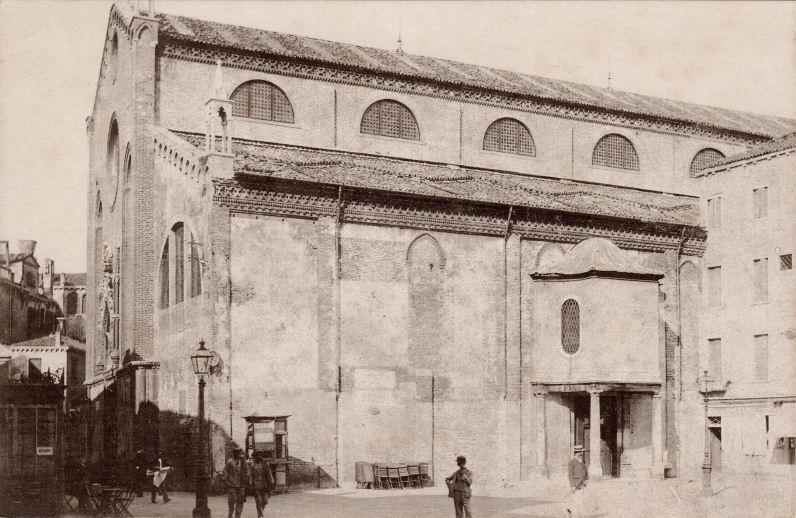
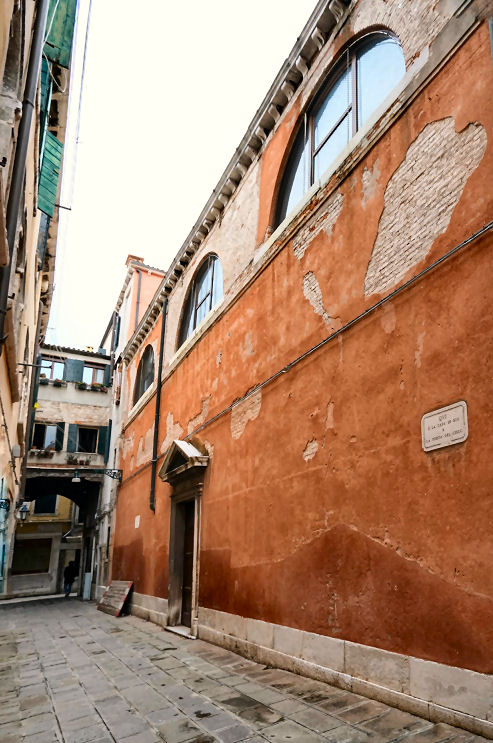
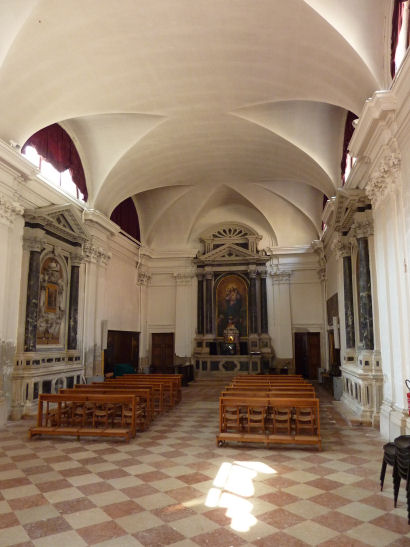
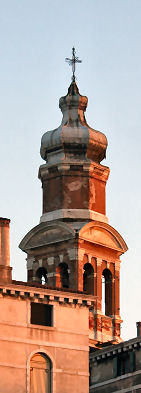
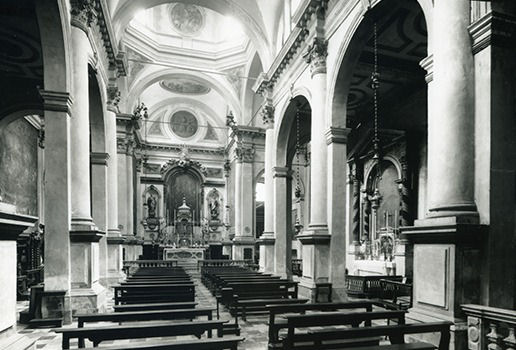
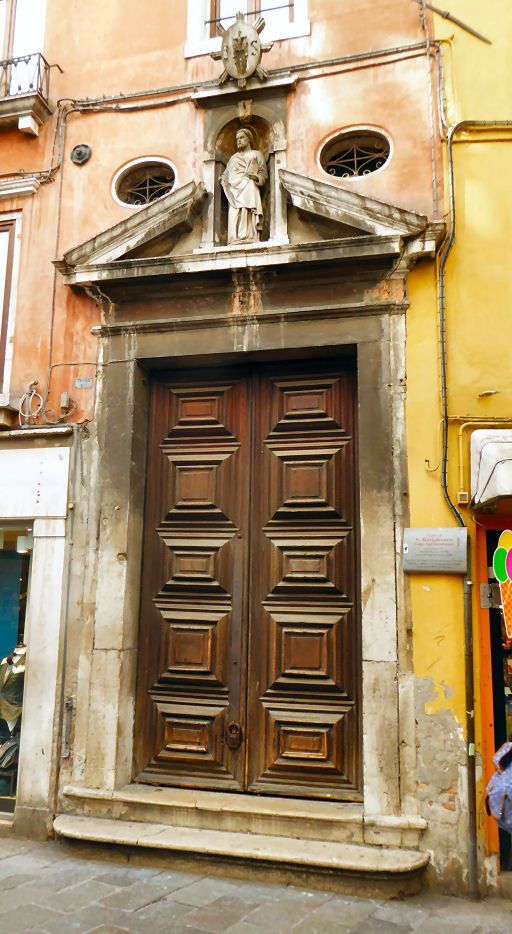
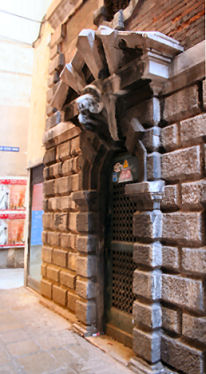
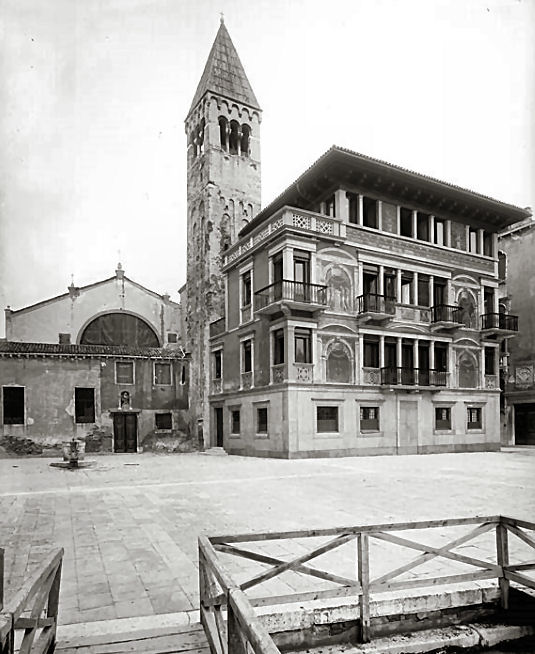
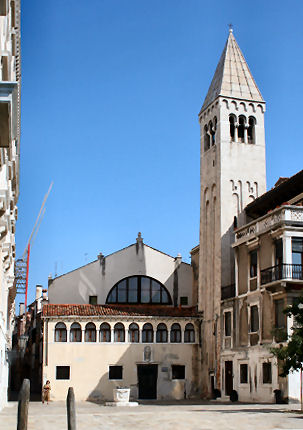
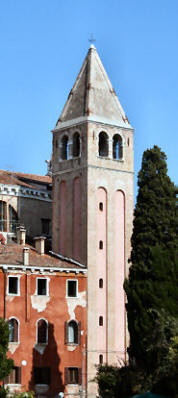
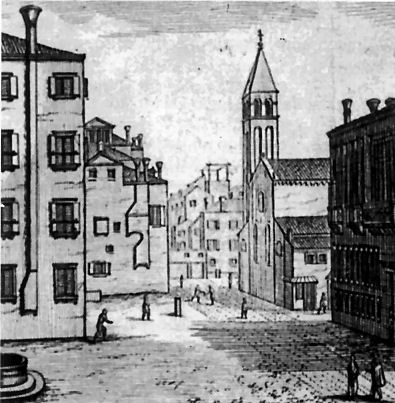
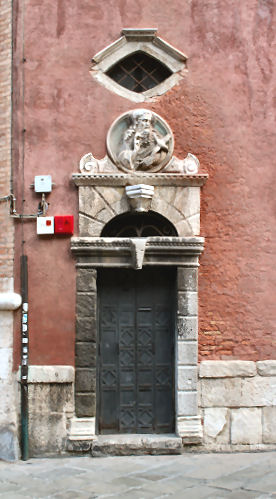
History Tradition says a small church dedicated to San Demetrio (Saint Demetrius), the martyr of Thessalonica, was built here in 836, but the first documentation dates to 1083. In 1170 the church was rebuilt and re-dedicated to San Bartolomeo, being used from the 13th century onwards by German merchants from the nearby Fondaco dei Tedeschi (which is now a glitzy shopping mall) the minister here being used for baptisms and funerals by the Germans as an 'official' front for their secretly-observed protestant beliefs. The church is said to have been used as a civil service school in the 15th century. A rebuilding of 1723, possibly by Giovanni Scalfarotto, is the church we see today. It was closed and deconsecrated in the 1980s following decades of neglect, and reopened as an art gallery. After a recent restoration it was being used for concerts. The church Only a door and the rusticated campanile base can be seen at street level. The carving of the grotesque face in the pediment over the entrance at the base of the campanile may be a reference to the suffering of Saint Bartholomew, whose martyrdom involved his being whipped and flayed. Art highlights All the art (including paintings by Palma Giovane and sculpture by Heinrich Meyring) was removed when the church was deconsecrated, apart from the sculptures by Meyring on the altar and the choir loft at the rear of the church. A fresco over the altar also remains, depicting Saint Bartholomew in Glory by Gian Maria Morleiter.
Lost art
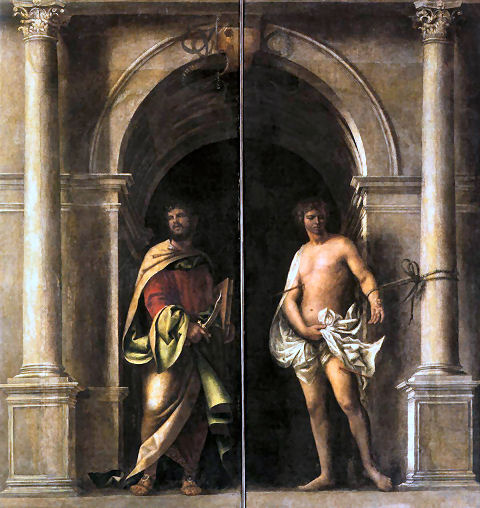
Organ shutters by Sebastiano del Piombo, painted 1510-11, showing Saints
Bartolomew and Sebastian, on the outside (see right above), and
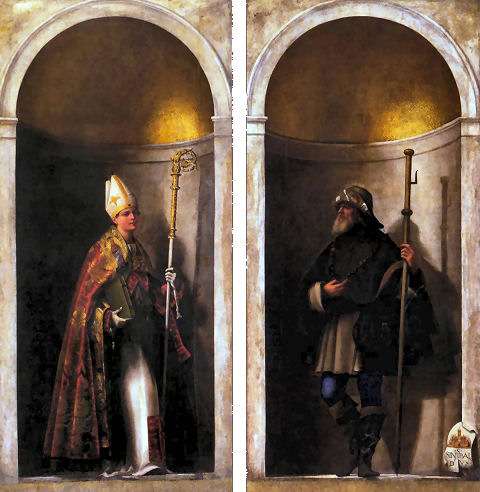
Saints Sinobaldus and Louis of Toulouse,
on the inside (see right below), are now in the Accademia on one
wall in a room in the new sequence of rooms devoted to the 15th and 16th
centuries. They
were commissioned by a priest of the church called Alvise Ricci and paid
for from his bequest following his death in 1509. His arms can be seen
painted over the arch on the exterior of the doors. The doors where were taken from the old organ
when it was destroyed,
sometime between 1733 and 1771. They were transferred to the Accademia in
1940, returning to this church at an unknown date, but they where reported
as here in 1954. They probably returned to the Accademia in 1977, came
back here, and then returned to the Accademia in 1980. Most of their
vaguely recorded trips to the Accademia resulted in conservation works
there, before more
restoration by Venice in Peril, undertaken for the Genius of Venice exhibition
at the Royal Academy in London in 1983. (Saint
Sinibaldus (Sebald), said to have been an Anglo-Saxon missionary to
Germany, is the patron saint of
Nuremberg, where he lived as a hermit. One of his miracles was using
icicles as fuel on the fire of a poor man who had given him shelter but who had no
wood.) |
|
|
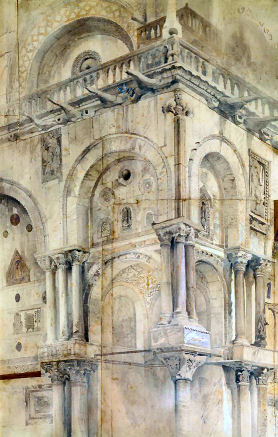
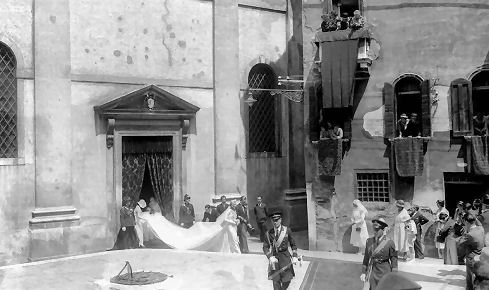
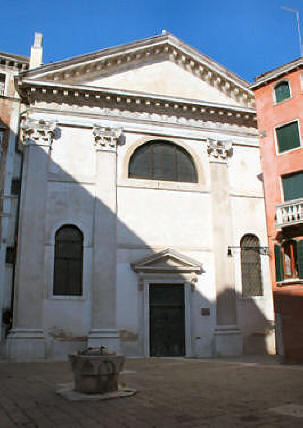
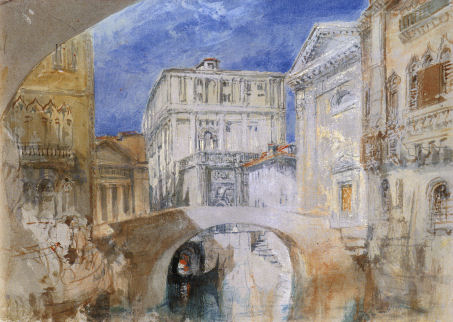
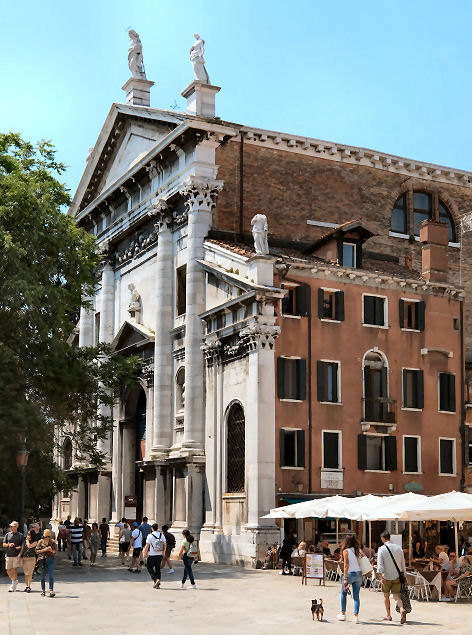
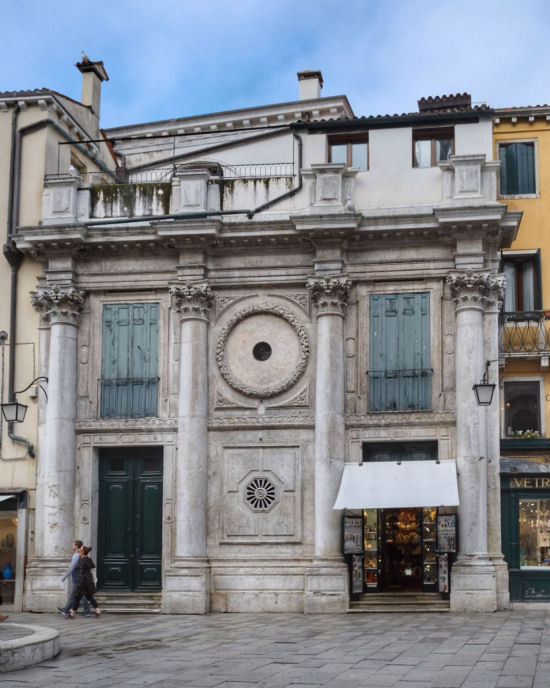 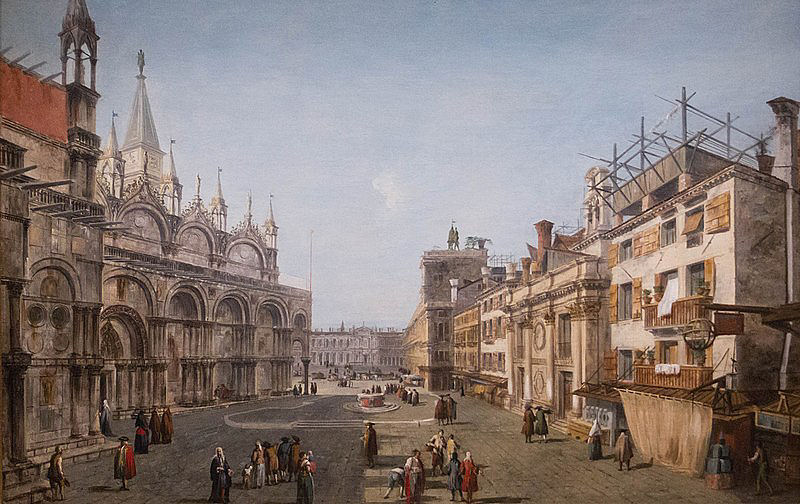 History Facing the side entrance to the Basilica San Marco, the original church on this site was built in 1076 and was rebuilt after the fire of 1105 which destroyed 23 churches in total. It was again damaged by fire in 1661, when the altar decorations caught fire, and rebuilt in 1665. This last church, the current building, was probably designed by Giuseppe Benoni with the facade (right) added 10 years later by Baldassare Longhena, but never finished - its upper part was never built. Closed by Napoleon in 1806, the church was sold and after 1847 acquired by the Basilica for storage. It was restored in 1951 and has since hosted an antiques shop, exhibitions and Vivaldi concerts. It's currently the automated cloakroom for visitors to San Marco Basilica. Campanile A small Roman-style campanile was built - it's just visible in the painting left. Upon suppression it was removed to Santissimo Nome di Gesù. Local colour The Piazzetta dei Leoncini, which the church faces onto, also contains the Palazzo Patriarchale. Begun in 1837 this was the last major new building in the Piazza San Marco area. In the monumental neoclassical style, it roughly but noticeably echoes the facade of San Basso
The church in art |
||
|
|
|
|
|
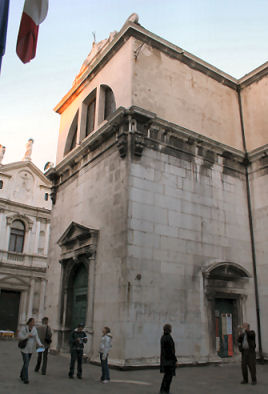
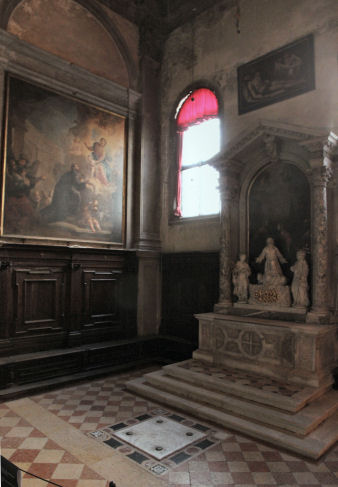
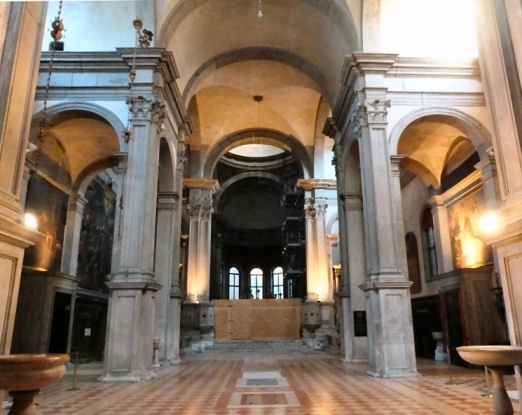
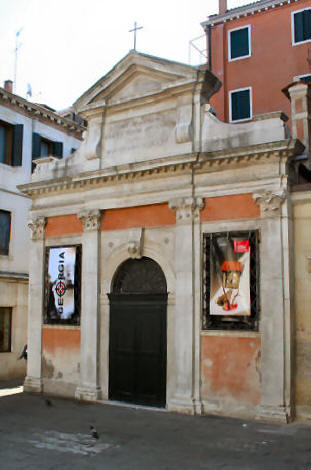
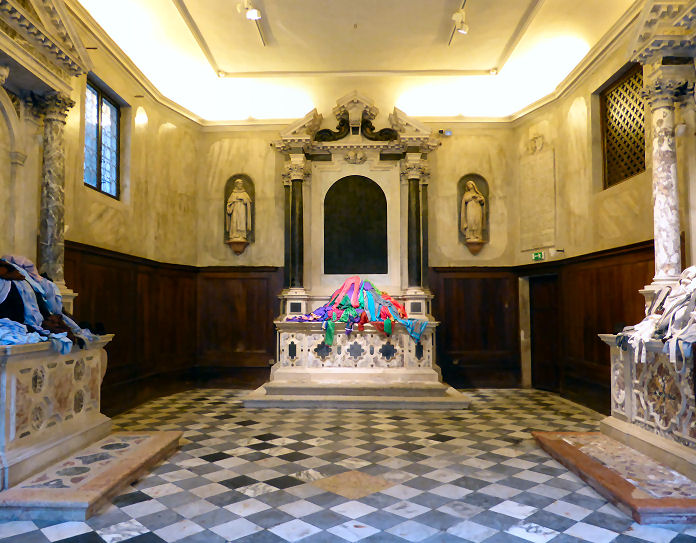
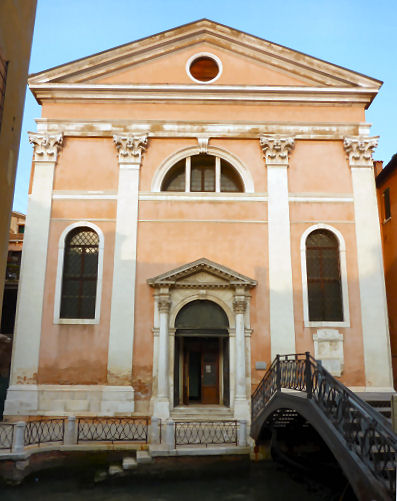
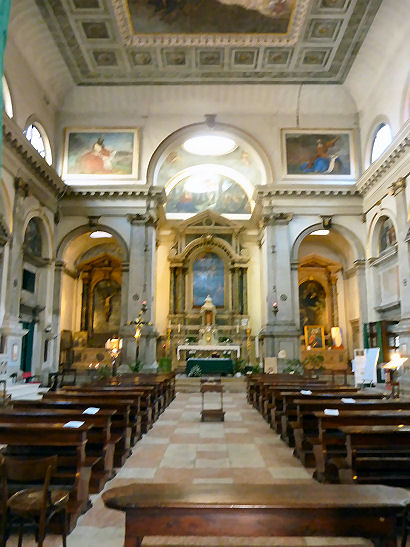
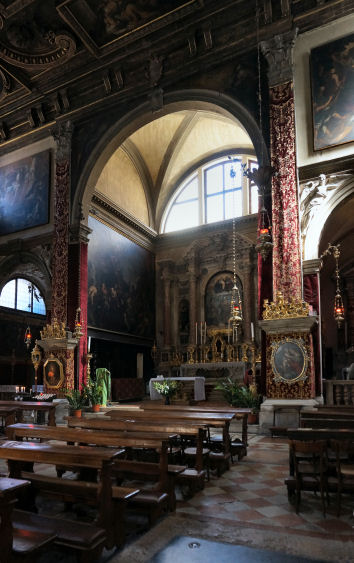
History Said to have been founded in the 9th century but the earliest documentary evidence dates from 1127. Rebuilt in the 15th century in a nave-and-two-aisles form, as clearly visible on the Barbari map. This church was demolished in 1506 and a new one begun the following year. It was to a design by Scarpagnino, who worked on the building until his death in 1549 when Jacopo Sansovino took over (with help from Alessandro Vittoria), designing the domed apse, and this building was completed in 1564. This was the guild church of the Scaleteri (vendors of biscuits and sweets) whose patron saint is San Fantin (Saint Fantinus of Calabria, San Fantino in Italian ). Amongst the church's relics are the body of Saint Marcellina (the older sister of Saint Ambrose of Milan) and an arm bone of Saint Trifone. The church A plain façade and exterior of Istrian stone. The exterior view of Sansovino's apse was blocked by some 'poor houses' which were cleared away in 1931, as a tribute to Luigi Marangoni, Procurator of San Marco, and paid for by a group of his friends. The interior Monumental and made of squares, I'd read, so was keen to get in and have a look during the 2011 Biennale. The darkness and the largeness of the art made appreciating the interior difficult, but it has an odd and interesting plan and is indeed made of cubes. Grubby dark grey stone detailing, with a couple of side altars visible towards the back. There's a monument to Vinciguerra Dandolo by Tullio Lombardo (an urn over the door to the sacristy) and paintings by Leonardo Corona and his pupil Sante Peranda, and several by Palma Giovane, another of Peranda's teachers. Also a 15th-century Tuscan polychrome wood crucifix the restoration of which was paid for by Venice in Peril in 2002. This crucifix was the one that was carried in front of condemned prisoners from the Doge's Palace dungeons to the place of execution between the two columns on the Piazzetta. There is an icon, said to be miraculous, possibly by Andreas Ritzos, presented to the church by the Pisano family. It may have been brought back to Venice from Candia (Crete) by Giovanni Pisano (Domenico Pisani?) who was Duke of Candia from 1475-77 (1480?) Lost art/Ruskin wrote Said to contain a John Bellini, otherwise of no importance. This was probably the Virgin and Child with Saint Joseph 'in front of a landscape and damasked curtain' which Crowe and Cavalcaselle in their History of Painting in Northern Italy in 1871 described as being by 'a nerveless follower of Bellini in his last days'. It's now thought that this could well be the Holy Family by Pier Francesco Bissolo which is now in the Sant’Apollonia Diocesan Museum of Sacred Art. There's also talk of a Tintoretto Visitation and two by Piazzetta - a Pieta and The Liberation of Venice from the Plague. Opening times 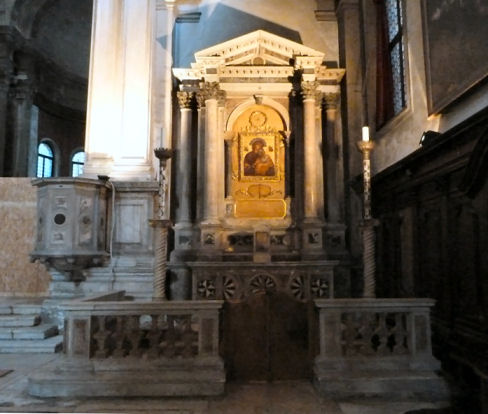 Never Except Summer 2011, when it was open and housing some Biennale stuff, and then after that stuff was removed, until Jan 2012, when it remained open. And Yvonne T took photos (the two to the right). Update January 2022 A news report on the Nuova Venezia website from July 2020 says that the never-open churches of San Bartolomeo, San Beneto and San Fantin in the San Marco sestiere were about to open. This doesn't seem to have happened, but the intention was there, and may persist. Let's hope. Vaporetto Santa Maria del Giglio The Scuola has it's own entry on the Scuole page now. map |
|
|
|
Interior photo taken by Brigitte Eckert during the 2015 Biennale |
||
|
The church in art |
|
|
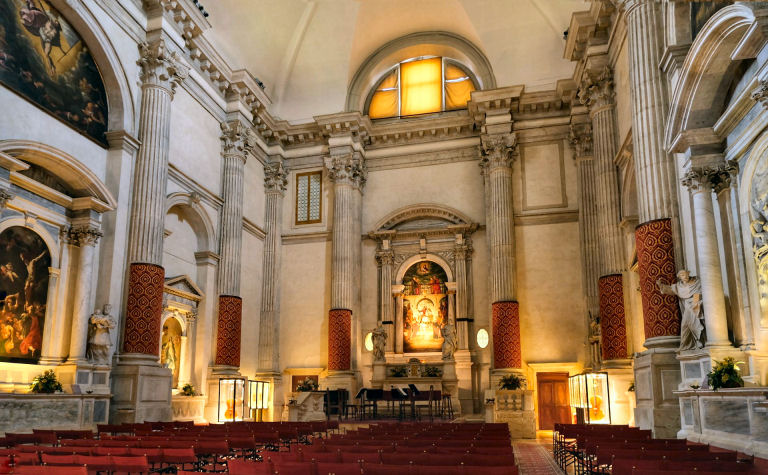
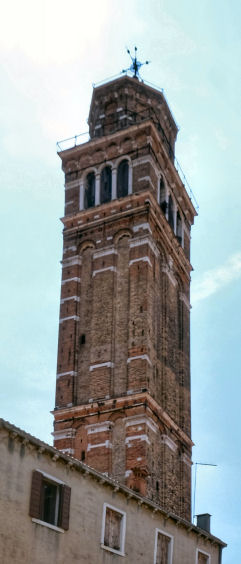
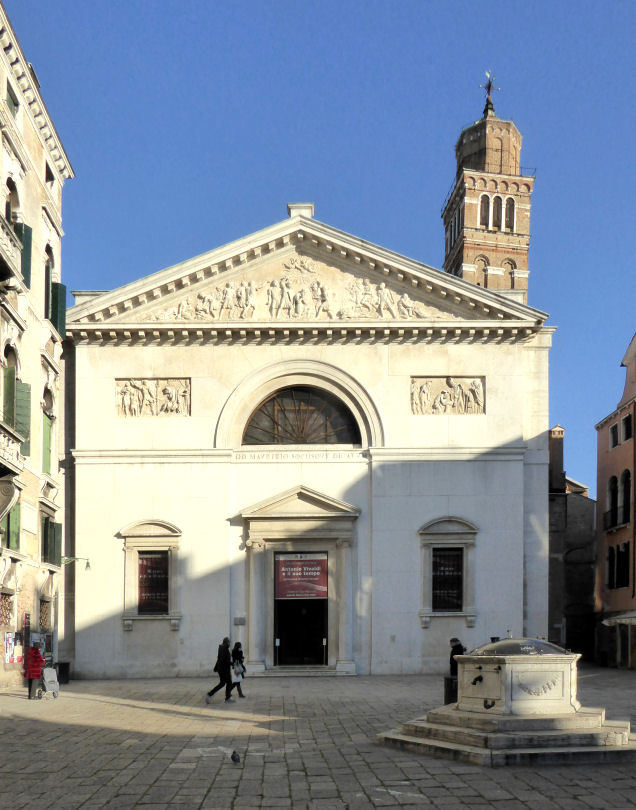 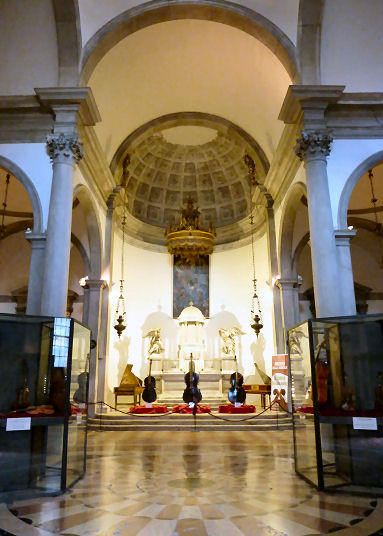 History Tradition says the original church was built in the 9th century, but the earliest recorded mention is dated 1084. Rebuilt after the fire of 1105 and in 1590. The present neoclassical church dates from a rebuilding of 1795-1806, for patrician Pietro Zaguri, by Giannantonio Selva - the façade and altars being by Selva. The work was finished after Selva's death in 1819 by Antonio Diedo and the church consecrated in 1828. This rebuilding was carried out so that this church would replace Sansovino's demolished church of San Geminiano, with the design of the interior supposedly inspired by that church, and the work of Codussi. The church A severely classical façade with an Ionic portal and rectangular reliefs by Bartolomeo Ferrari and Luigi Zandomeneghi either side of the lunette. A relief of the life of the saint is in the pediment above. Interior A Greek-cross plan with a central cupola surrounded by four bays each with a blind cupola. The church having been deconsecrated, the interior has been stripped and is now full of the 120-odd 18th-century stringed instruments that were collected of Artemio Versari. But it is still quite a pleasing square space and worth a visit. Campanile The De Barbari map shows a tower from after the 1105 fire, on the opposite side of the calle, topped with a cone-shaped spire and four pinnacles. This was demolished to make way for the house of oil and flour merchant Dionino Bellavite, who from 1564 onwards paid a fee 'for the demolished campanile'. A Roman-style bell tower built was in 1795. (The leaning campanile in my photo left belongs to Santo Stefano.) Opening times 9.30-8.30 Free entrance Vaporetto Accademia map |
||
|
San Moise |
||
|
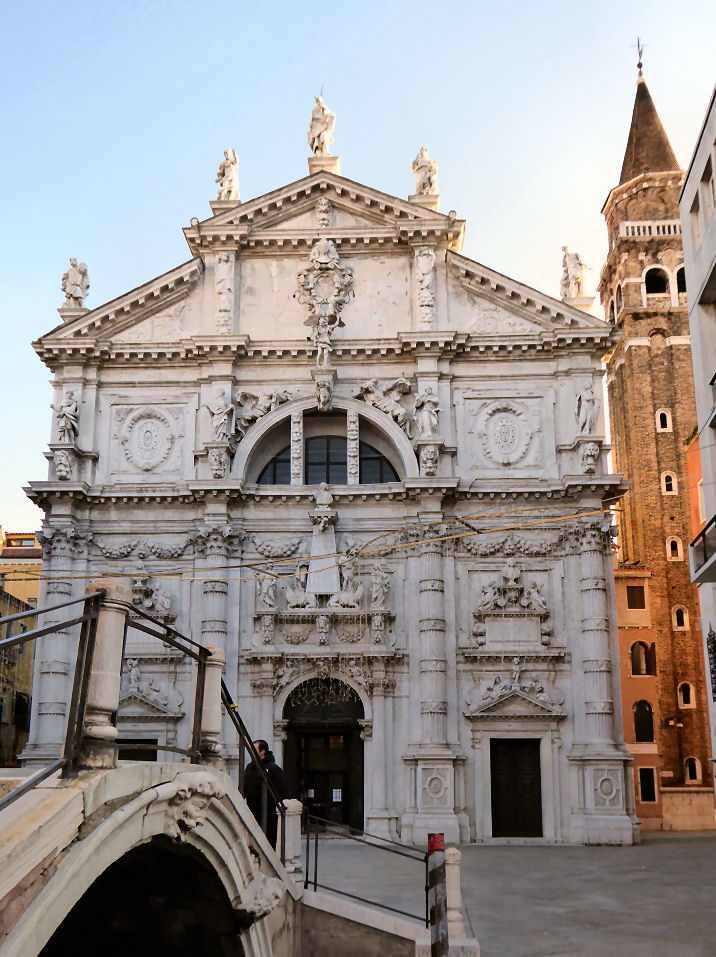
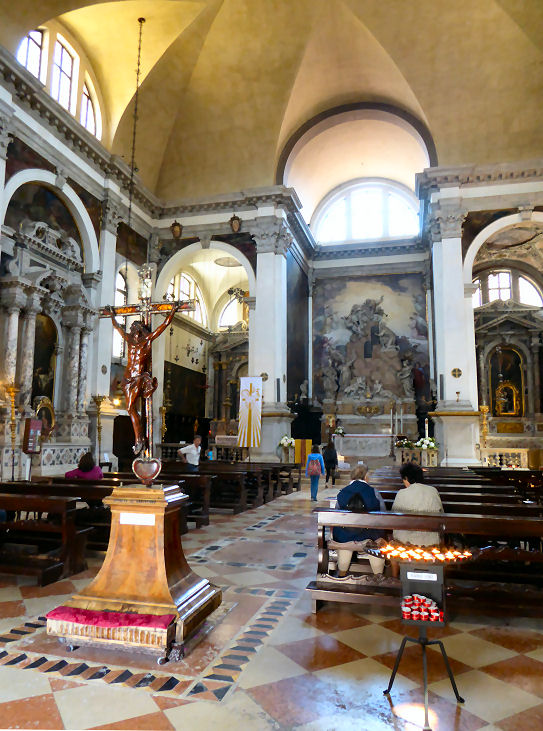
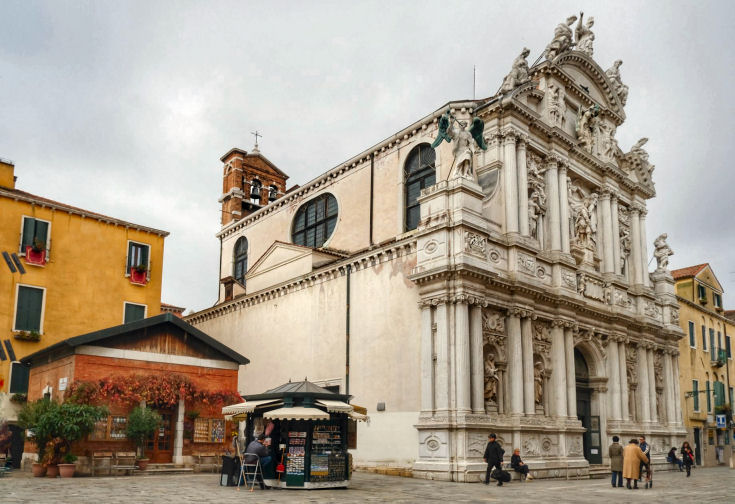
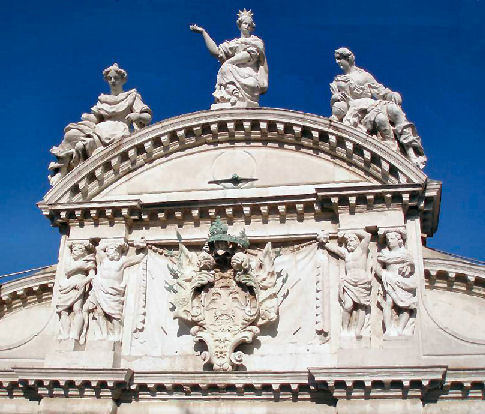
The church The first church on this site was said to have been built of wood in 797 and dedicated to San Vittore. The second was built in 947 by Moisè Venier and dedicated to his name saint. Venetians being in the Byzantine habit of looking upon Old Testament prophets as saints. This church was renovated after the second fire of 1105. The current church dates from a rebuilding of 1632. Work on rebuilding the façade began in 1668 to designs by Alessandro Tremignon, and at a final cost of 30,000 ducats. The reconstruction was paid for by the Fini family and it's Vincenzo Fini, who was made Procurator of San Marco in 1687, whose bust sits atop the central obelisk on the facade over the door, propped up by angels, saints and a pair of camels. In the order above you'll find four virtues, with sibyls at the top. The whole theatrical thrust of the facade is to the glory of the Fini, and represents the mercantile lives of the brothers. All the decoration is by Flemish sculptor Heinrich Meyring (sometimes Italianised to Merengo) who also carved the massive sculpture on the altar inside, with the help of Tremignon, seemingly out of a rock. It shows God handing the tablets to Moses. There is also a Washing of the Feet by Tintoretto, a late work from c.1590/92, and a Last Supper by Palma Giovane. The grave of John Law, the man behind the Mississippi Bubble, is in this church, near the entrance. He died in poverty in Venice in 1729. The church in art 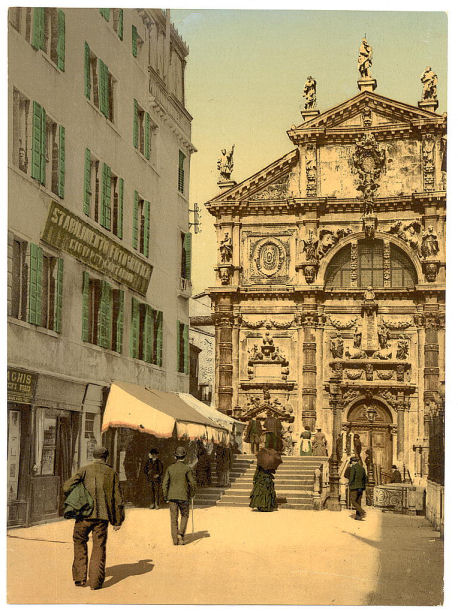 John Piper produced a lithograph of the façade in 1961 Ruskin wrote Notable as one of the basest examples of the basest school of the Renaissance. It contains one important picture, namely, "Christ Washing the Disciples' Feet," by Tintoret; on the left side of the chapel, north of the choir. This picture has been originally dark, is now much faded, - in parts, I believe, altogether destroyed, - and is hung in the worst light of a chapel, where, on a sunny day at noon, one could not easily read without a candle. I cannot, therefore, give much information respecting it; but it is certainly one of the least successful of the painter's works, and both careless and unsatisfactory in its composition as well as its colour. The late-renaissance habit of using the façades of churches to glorify generous benefactors he said was a manifestation of insolent atheism. (Statues in public spaces were forbidden in Venice so this was a way of circumventing the law.) Campanile 47m (153ft) electromechanical bells 14th century with fired brick spire. Opening times Daily 3.30-7.00 officially, but it seems to be open most of the day. Update January 2024 Campanile still covered in scaffolding. Vaporetto Vallaresso map 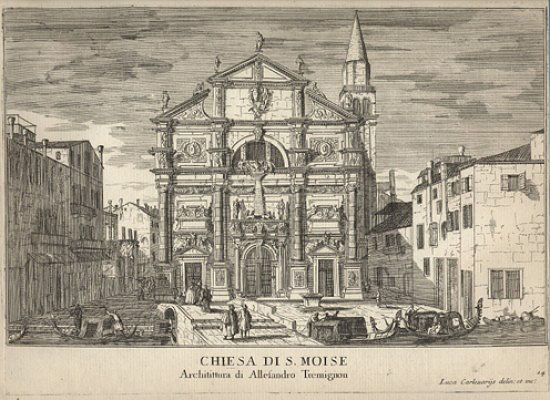 |
|
|
|
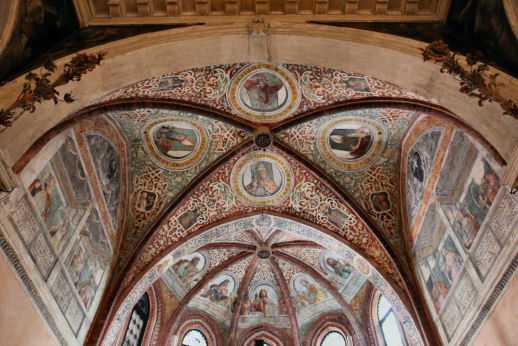
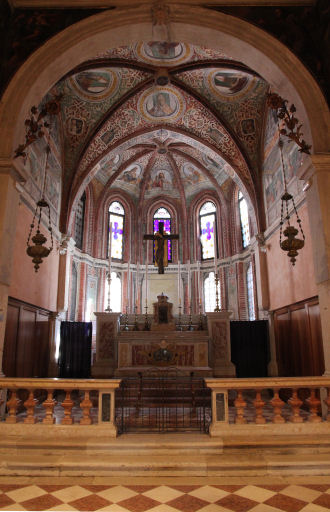
The 15th-century frescoes in the presbytery and apse are pretty spectacular, though (see above), having been discovered under plaster in 1882 during restoration work and restored again in 1946 and 2000. They are by an unknown artist and have over the years been described as School of Mantegna and Paduan School. Studies on the frescoes are ongoing, but the work seems to be by a team of artists probably not from Venice. They show Christ, the Four Evangelists, the Four Fathers of the Church - Saints Augustine, Ambrose, Jerome, and Gregory - and the Eight Sibyls. The Crucifix of 1350/55 is said to be by Paolo Veneziano.
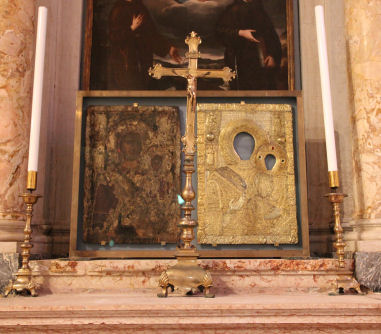
Over the altar at the end of the aisle to
the right of the sanctuary there's a 13th-century icon of the Virgin and
Child (see photo above) displayed alongside its revetment.
This latter covering is 14th-century and also Byzantine. It's decoration
reproduces the icon underneath, with an Annunciation in the top
corners and 45 small figures and scenes in the framing. It was brought to Venice
from Nauplia in Greece in
1541 by Francesco Barbaro, who was governor there, before the city passed
to the Turks. Further work on it was undertaken in Venice at this time and
it
was restored in 1995. Campanile
28m (91ft) manual bells
The church in art |
|
|
|
A print from around 1717 showing the
church
|
|
|
|
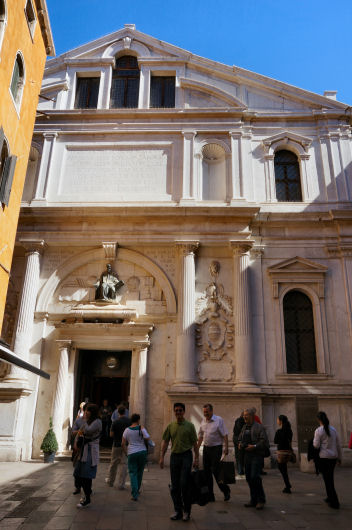
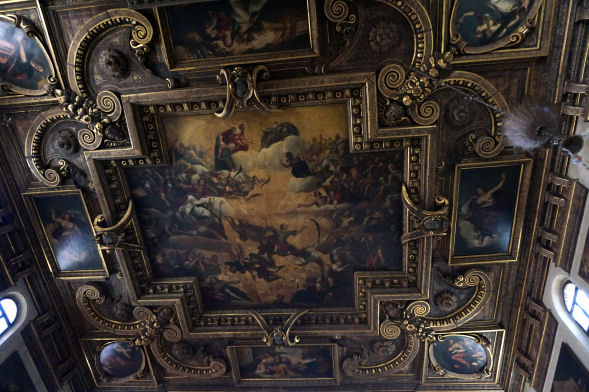
History Tradition says that the church of Santi Zulian (Venetian dialect for San Giuliano) e Basilissa was founded around 829, but the church is first documented in 1061, and some sources say that it was rebuilt after the second fire of 1105, at the expense of the Balbi family. By the mid-15th century this church is said to have been in a poor state. The current church dates from a rebuilding commissioned in 1553 by Tommaso Rangone, a physician and astrologer from Ravenna who could not be accused of undue modesty. He made his fortune from syphilis cures and wrote a book on how to live to 120 which was based on his observations regarding the longevity of Venetians. (He lived to the age of 84, since you asked.) His obsession with longevity may explain his ceaseless quest for immortality in paint and stone. He is depicted in major roles in Tintoretto's paintings for the Scuola di San Marco (now in the Accademia) for which he became Guardian Grande. He had also wanted to be commemorated by an effigy on the façade of San Geminiano, the church which used to face the Basilica across Piazza San Marco, but this request was refused by the Signoria as too vainglorious. Jacopo Sansovino was put in charge of San Zulian's rebuilding, which began in 1566, after thirteen years of fund raising. But while he was building a new façade the roof collapsed and he had to start again from scratch. Alessandro Vittoria collaborated with him towards the end and the church was finished and consecrated in 1580, ten years after Sansovino's death. Rangone, who died in 1577, kept the architect's model and made arrangements for it to be carried in procession during his funeral. He's buried in the chancel here. His marble coffin is said to have been made in the shape of his body. It's also said that his bones were transferred to the island of Sant'Ariano in 1822. The church 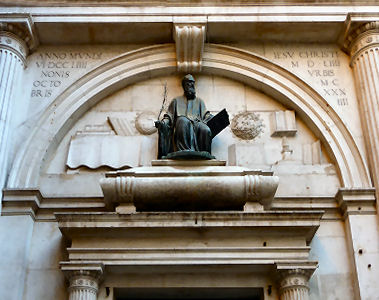 That's a bronze statue of Rangone by Sansovino, made in 1554, in the arch over the door (see right). Rangone is depicted holding sarsaparilla and guaiacum, two of the ingredients of his syphilis cure. The portico is recessed, rather than sticking out, because of space constraints. The façade also features odd symbols and inscriptions in Latin, Greek and Hebrew telling us what a great and generous man Rangone was. This is one of only two freestanding churches in Venice (i.e. ones that can be walked all around). The other is Angelo Raffaele. Much work was carried out here by Venice in Peril in the early 1990s. This included cleaning and applying protective substances to the façade and the statue of Rangone, which also needed protecting from pigeons. Much work was done then on the interior too. The interior A square aisleless nave almost totally, and oddly, free of architectural detailing, having just two Corinthian pilasters framing the sanctuary, but there's lots of gold and works by Palma Giovane including, I have to admit, quite a nice Assumption. Appreciation of the painted ceiling is much improved by putting some coins in the light, but it is a light of somewhat stingy duration. 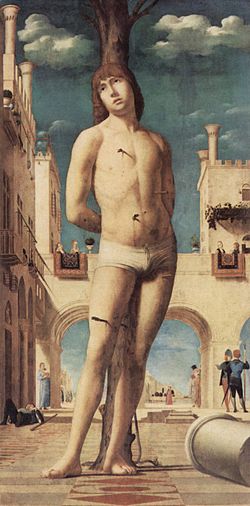 Art highlights Saints by Vittoria and four paintings, including the central cross-shaped ceiling painting The Apotheosis of Saint Julian, by Palma Giovane (see below right). The surrounding Virtues on the ceiling are by Leonardo Corona. Jacopo Tintoretto famously somewhat desperately subjected himself in his maturity to a competition involving painting the Assumption of the Virgin for the Marzeri (merchants) here. He lost out, by one vote to four, to the young upstart Palma Giovane. The first altar on the right has an unobvious Pietà by Veronese from 1584, with Saints Roch, Jerome and Mark below by assistants. Opposite the Veronese Pietà is Boccaccio Boccaccino's attractive Virgin and Child with Saints, which has a sweet air of Bellini and Giorgione about it. Also a Last Supper formerly attributed to Tintoretto but now said to be by the studio of Veronese. It's mentioned by Ridolfi. During repairs to the roof in 1909 a huge roll, thickly coated with dust and cobwebs, and after much cleaning, it was discovered that the roll consisted of numerous canvases. It turned out that around 1830 the rector of San Zulian, deciding that his church was a bit dark and gloomy, decided to remove the paintings from the clerestory windows and replace them with panels of light-coloured marbles. Paintings by Tintoretto, Palma Giovane, Leonardo Corona and others were removed and stashed under the roof. These works were Christ Bearing the Cross at Calvary by Tintoretto; Ecce Homo and The Resurrection, by Palma Giovane; The Deposition, The Flagellation, The Crowning with Thorns, and Christ before Caiaphas by Corona; The Agony in the Garden and The Washing the Disciples' Feet, by Giovanni Fiamengo; and a Saint Jerome, and a Saint Theodore by Andrea Vicentino. A 1909 article in the Burlington Magazine said that the paintings by Tintoretto and Fiamengo were in 'a deplorable state', but that 'it is already supposed that one and all of them will in time be re-hung in the places for which they were originally intended'. Update August 2018 The truth of this (recently discovered) story needs to be checked. Lost art 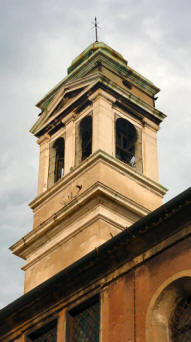 A triptych featuring paintings of Saint Christopher and Saint Sebastian by Antonello and his son Jacobello da Messina either side of a wooden statue of Saint Roch was recorded here in 1581 by Francesco Sansovino. The Saint Sebastian panel (see right) by Antonello, is now in the Dresden Gemäldegalerie. Relics The body of Saint Paul the Hermit was brought here from the church of Theotokos Peribleptos in Constantinople following the Latin Sack of 1204, during the forth crusade. Campanile manual bells De Barbari's map shows a tower, presumably built during the second rebuilding, topped by a sugar-loaf spire and four pinnacles. The current tower dates from the demolition of this old campanile in 1775 and is the only one in Venice that rests on the roof of its church. Opening times Daily 8.30 - 7.00 Vaporetto San Zaccaria map |
|
|
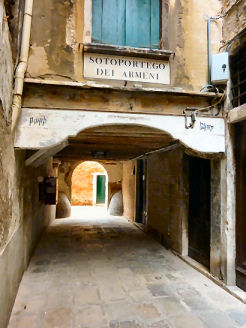 History A house on the site was supposedly given to the Armenians around 1253 by Marco Ziani, the son of Doge Pietro Ziani, grateful for the fortune he'd made in their country. An oratory was built in 1496 as Santa Croce di Cristo (the Sacred Cross of Christ). This was rebuilt as a church in 1682-88 and renovated in 1703. The small Armenian population of Venice later began attending services at the monastery on the island of San Lazzaro degli Armeni and this church fell into disuse. It has recently come into use again, once a month. 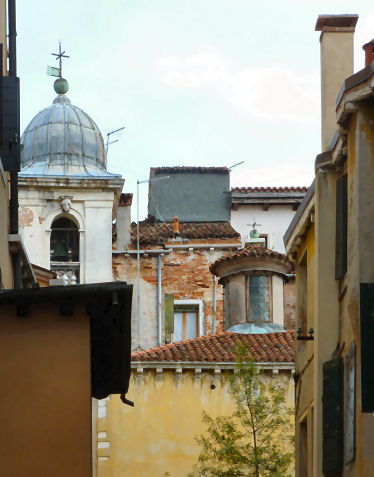 The church The discrete entrance is off the Sotoportego dei Armeni - the farther of the two doors in the photograph of the sotoportego (see left). The church has a small square interior, richly decorated in a classical style with a central cupola. Sardi and Longhena are sometimes suggested as possible architects. The altar paintings date from the period of the restoration. Campanile 24m (78ft) manual bells Hard to see (see right) dating from 1682-88 too, and with an onion dome. Opening times For mass only, in Armenian, on the last Sunday in the month at 10.30. Vaporetto Vallaresso (San Marco) map |
||
|
Santa Maria del Giglio |
||
|
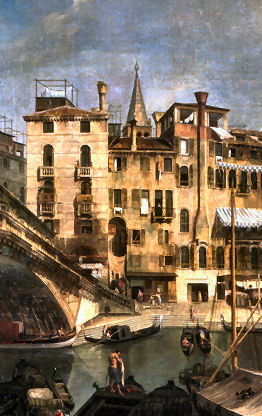
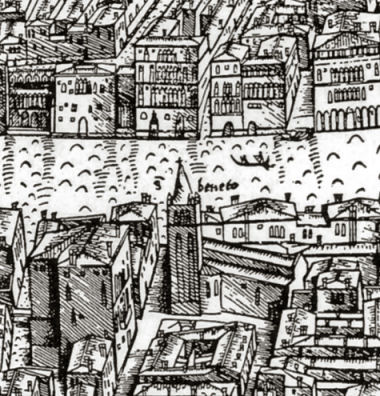
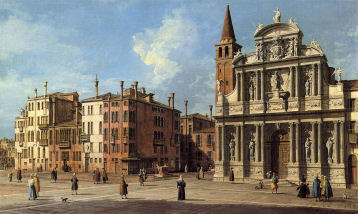
History The original Byzantine-style church was said to have been founded by the Slav Jubanico family, a name corrupted over time to Zobenigo. Hence the church's other name Santa Maria Zobenigo. The church burnt down and was then rebuilt in 976, and again in 1105. This latter church survived until the present church, whose name translates as Our Lady of the Lily, was built in 1680-83 by Giuseppe Benoni, with the façade and side altars by Giuseppe Sardi. Similarly to the nearby Santo Stefano this church has its side onto a broad campo with its façade facing a narrow calle. It underwent restoration in 1833. The church The façade is another of the irreligious self-glorifying displays that Ruskin condemned, along with San Moise, as a 'manifestation of insolent atheism'. Here it's Antonio Barbaro who left 30,000 ducats in his will with precise instructions as to how Sardi was to celebrate his political and military careers. The heavily populated façade has Barbaro's four brothers, clothed according the public offices they held, on the lowest level, with Barbaro himself on the next level up, over the door, all sculpted by Giusto Le Court. Hoards of allegorical figures and putti keep him company. Also some angels because this is a church after all. The plinths under the pairs of Corinthian columns on this upper level show battle scenes, whilst the plinths under the Ionic columns at ground level show plans of the cities of Antonio's military triumphs: Zara, Candia (Crete), Padua, Rome, Corfu and Spalato (Split). Interior and art highlights A compact and aisleless space, with three shallow altars either side. There's an impressively detailed big arch over the high altar, with an organ behind. Meyring statues of The Annunciation flank the high altar. 17th-century artists dominate, which just about excuses the Rubens, he being of the same period. This church has the only Rubens in Venice, you see, behind bullet-proof glass in the Molin Chapel (entrance to the right) - a fleshy Virgin and Child with the Young St John, not really in keeping with its surroundings. And some guide books use words like 'alleged' and 'attributed'. This chapel has a ceiling painting by Domenico, Jacopo Tintoretto's son, and lots of extravagantly designed reliquaries with bones, nicely labelled. Remains include hanks of hair and other hard-to-identify bits that it's probably best not to know or enquire about. Over the third altar on the left there's a Tintoretto altarpiece depicting Christ with Angels and Saints Justina and Francis of Paola.of 1581/2, possibly by the young Domenico. There are also two sketchy pairs of Evangelists by Jacopo, from 1557, on either side of the choir behind the altar. They were the inner panels from a destroyed organ case and you can walk around behind the altar to get a better look. The contract for these doors survives and having not even started painting five years after they were ordered he ended up with just sixteen days to finish the job or lose the commission and be forced to return the payment already made. (This threat is dated 6 March 1557 - exactly 400 years before the day I was born!) The outer shutters (now lost) depicted The Conversion of Saint Paul. Also an impressive Last Supper by sculptor/painter Giulio Del Moro on the inside front wall, with four cute sibyls by Il Salviati ranged below. The Zanchi paintings high up over the main cornice look impressive from a distance. The paintings on the ceiling are by him too. There's also a sweet little carved high relief panel of Saint Jerome, and an overpowering carved baptistery crawling with putti. This is a church whose cumulative pleasures sort of creep up on you. 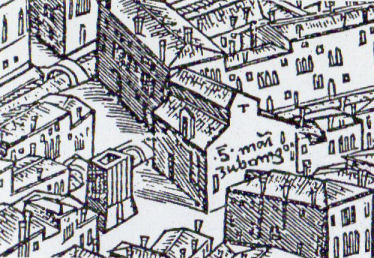 Campanile Visible in the Canaletto painting (see below), it was leaning a lot when it was demolished in 1774. Rebuilding began in 1805 but work only reached 26 feet - this stump is now a gift shop (see photo far right). Barbari's famous map shows a stump too (see right) but here it's because the tower was being built, suggesting that an earlier one had toppled too by 1500. The church in art Santa Maria Zobenigo by Canaletto (see right) from 1738/40, now in a private collection. It shows the demolished campanile when still intact. Guardi painted an almost identical view thirty years later, even copying some of the figures and groups. Ruskin wrote Mentioning the five churches he thought of as 'illustrative of the last degradation of the Renaissance. He calls Santa Maria Zobenigo the most impious. So incensed was he at the Barbaro family's vainglorious and atheistic appropriation of this church's façade that when he learnt, during his visit of 1851, that the last members of the once-great family, two old brothers, were then living in the garret of the nearby family palazzo Ruskin wrote to his father 'So they have been brought to their garrets justly'. Opening times Monday to Saturday: 10.30 - 1.30 and 2.30 - 5.00 Sundays: closed A Chorus Church A NO PHOTO! church Vaporetto Santa Maria del Giglio map |
Photo above by Vicky Greig |
|
|
The church Art highlights Ruskin wrote
Local colour |
|
|
|
|
||
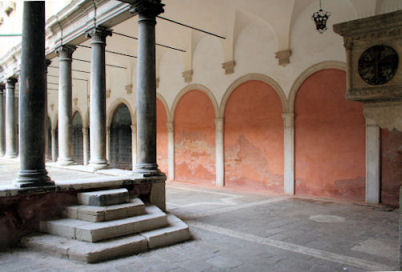
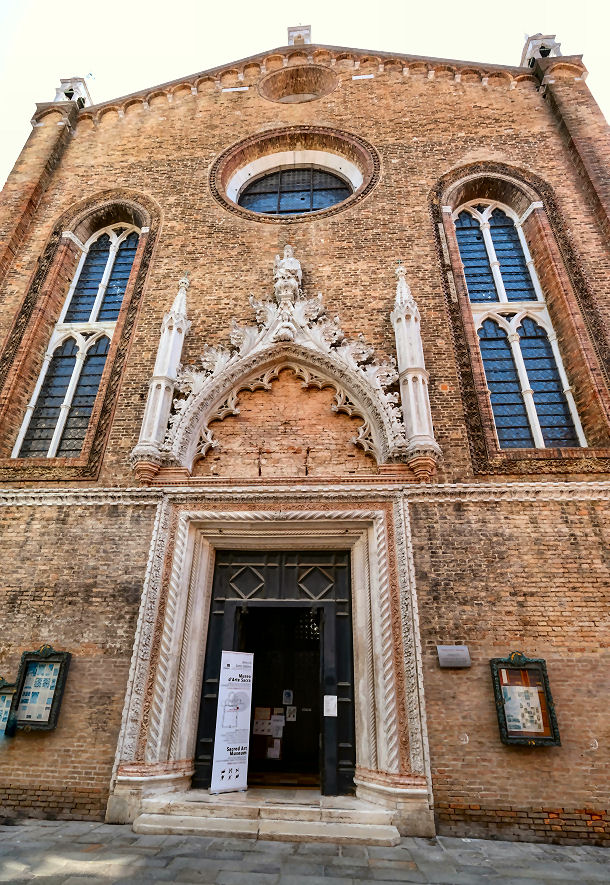
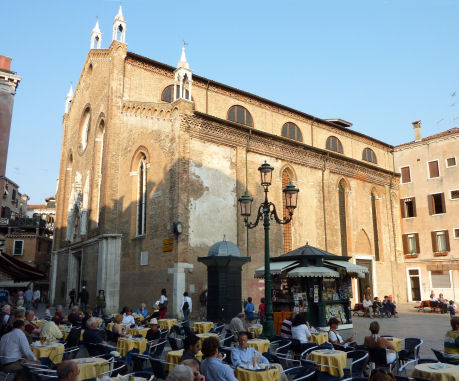
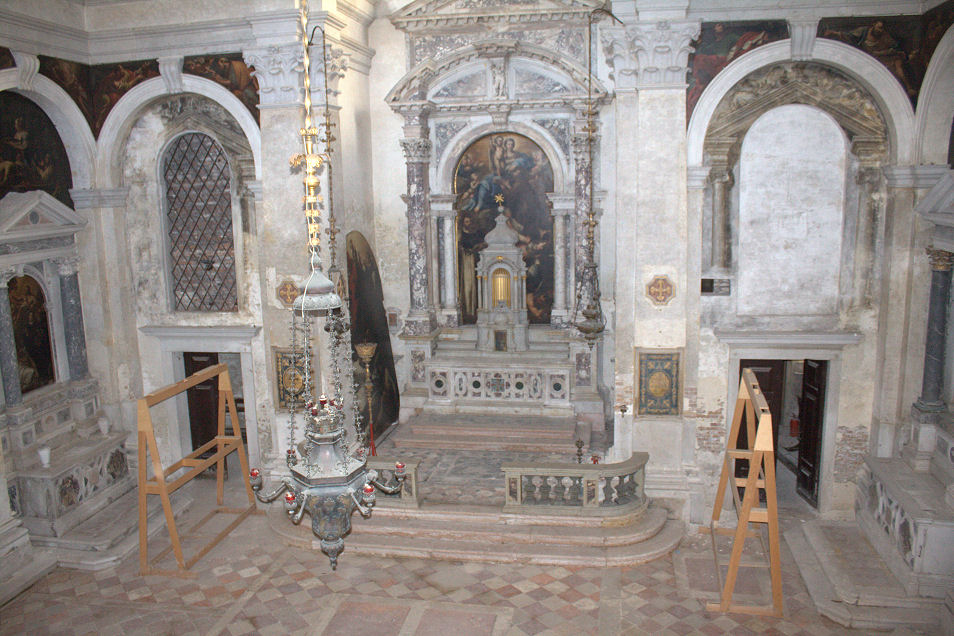
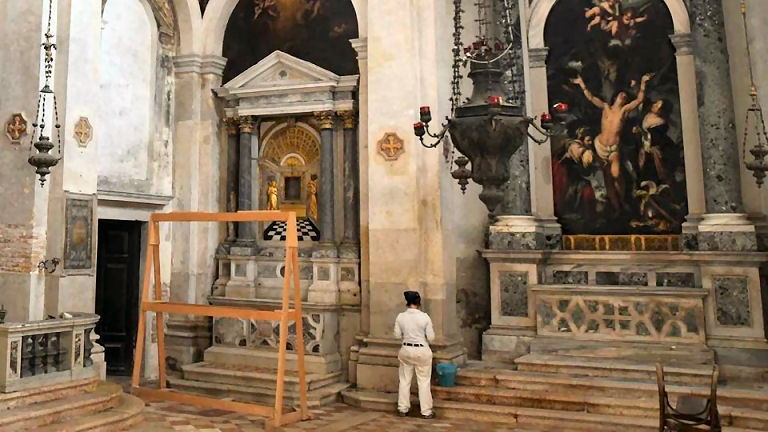
  History In 1485 the Scuola di San Rocco briefly moved to an oratory on this site with the intention of building a church to house the relics of Saint Roch, its patron saint, but soon moved to their present premises near the Frari. The oratory and some adjoining houses were given to the Cistercian nuns from the derelict monastery of Santa Margherita on Torcello who began construction of the church and convent here in April 1488, with contributions from the Augustinian friars of Santo Stefano and the Lezze family (Luca Lezze was Procuratore di San Marco in 1464) The church was consecrated in 1547. In 1597 an altar was built for the holy icon of the Virgin brought here from Lakonia in southern Greece. The monastery was suppressed in 1806, and the church closed in 1810. After some years of use as a music venue both were acquired in 1822 by the priest Pietro Ciliota, who founded a school for girls. Two of the five altars were sold, and the other furnishings dispersed. The Istituto Ciliota (since restoration in 1999) offers accommodation in the monastery.
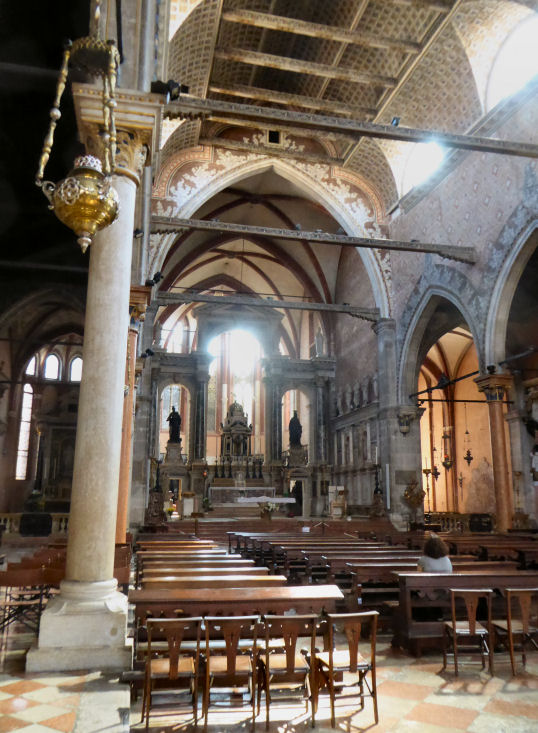
The interior |
||

Home
Cannaregio ::
Castello :: Dorsoduro ::
Giudecca :: San Marco ::
San Polo :: Santa Croce
:: The Islands :: Demolished


 and the last of the Carrara lords of
Padua, Francesco Novello was buried here, having been strangled in prison
in 1406 along with his two sons following their capture during a war
between Padua and Venice..
and the last of the Carrara lords of
Padua, Francesco Novello was buried here, having been strangled in prison
in 1406 along with his two sons following their capture during a war
between Padua and Venice..