|
Angelo
Raffaele
Francesco Contino 1618-1639
|
|
History
Tradition has it that this church, dedicated to the
Archangel Raphael, is one of the oldest in Venice, supposedly having been
founded in either 416 or 650. The latter date attaches to the legend that
it was the second of the eight churches founded by San Magno
(Saint Magnus of Oderzo). Another story says that when Attila attacked Italy for the second time
Genusio Rutenio,
Lord of Padua, sent his family to the island of Rialto. When his wife,
Adriana, arrived in Dorsoduro she vowed to build a church if her husband
returned safely. She built an oratory here where the Benedictine nuns from
San Zaccaria, whom she had befriended, could visit and worship. Adriana left
the oratory to the nuns, who kept it up until it was destroyed by a fire
which swept the whole district in 899. The church was rebuilt by the Candini and Ariana families. It became a parish church, which was
destroyed by fire in 1105. The first written record dates from 1193, the
year in which the church was rebuilt and reconsecrated following the fire.
That church was itself demolished in the 17th century, being considered to
be beyond repair.
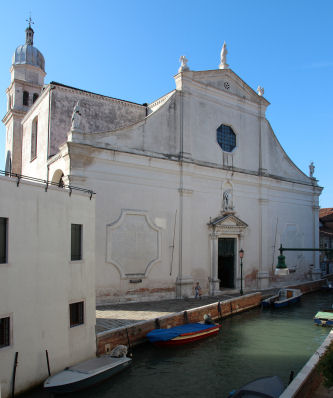
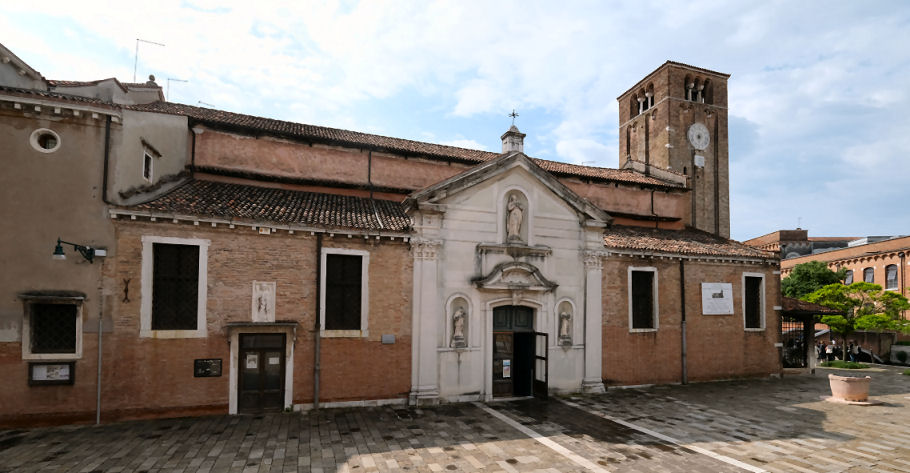
The current church was built in 1618-1639 to designs by
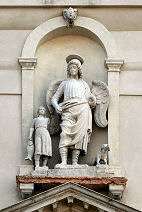
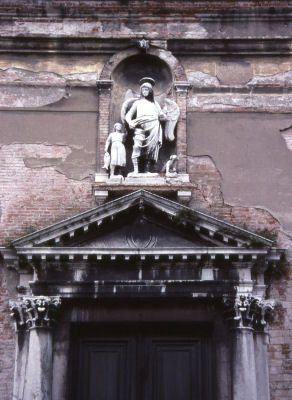
Francesco Contino, with further work in 1676 and 1685. The façade, facing onto a narrow canal, was rebuilt in
1735, with its statue group of Tobias, Raphael, the dog and the fish (see
below left)
dating from this time too, and said to be by Sebastiano Mariani.
The church became a
Chorus church, on the 8th
of July 2021, but now isn't.
The
church
The
restoration of the façade in 2004 left it looking like new but lacking,
some complained, that certain crumbling charm that it
possessed before (see above right). But the pristine look didn't last, of
course, this being Venice. This is one of only two churches in Venice that
are free standing, i.e. you can walk all around them.
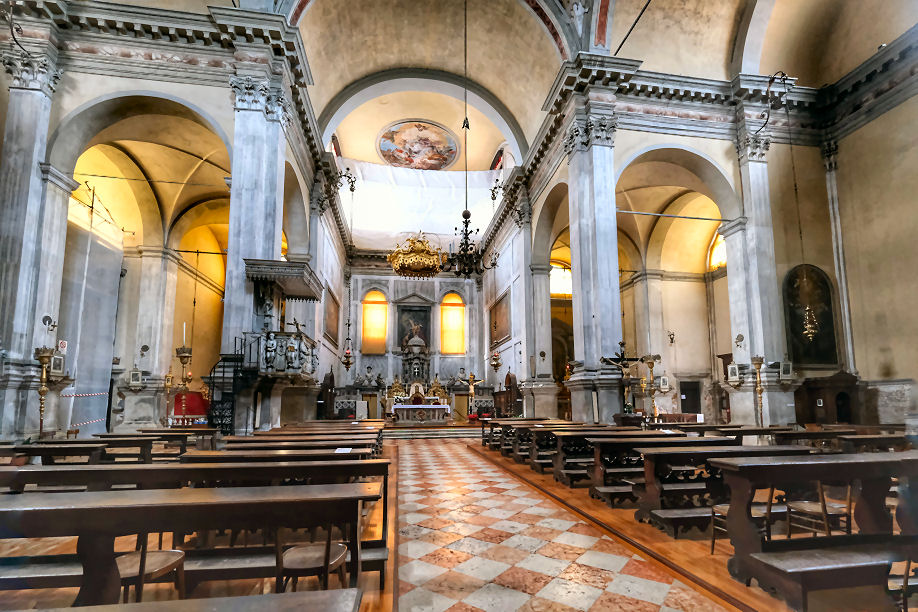
Interior
The church has its
original Greek-cross interior, which was reworked in the 18th century and
is given a warm glow inside by the orangey net curtains.
Art highlights
The 18th-century art
here holds little to surprise, and of course there's one by Palma Giovane. The organ over the entrance
(built 1743-49 by Antonio and Tommaso Amigoni) has a balcony divided into
five sections, each featuring somewhat feathery but strongly coloured paintings of
The
Life of Tobias by Giovanni Antonio Guardi (the elder brother of the more famous
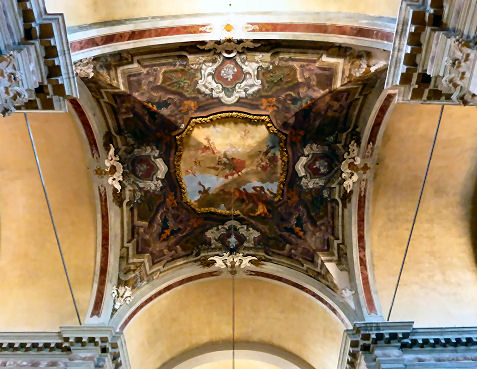
veduti-painter Francesco) in 1750-53. There's a central ceiling fresco by
Francesco Fontebasso, a pupil of Ricci and Tiepolo (see photo below
right)
which is a bit darkly out of tone, but impressive. And in the baptistery
(entrance to the right of the high altar), a tiny low room, the whole
ceiling of is covered with a fresco, also by Fontebasso. It's been much
altered, but recent cleaning has left it maybe a little too vivid.
Campanile
35m (114 ft) electromechanical bells
Rebuilt with the 18th-century's favoured form of the octagonal drum and
onion dome.
The church in fiction
This church is central to the action in Salley Vickers' novel Miss
Garnet's Angel and so it has become something of a pilgrimage destination
for
fans of that book. This possibly explains the spate of sprucings-up after the book
was published.
Opening times
Monday - Saturday 10.00 - 12. 00 & 3.00 - 5.30
Sunday and holidays 9.00 - 12.00
Vaporetto
San Basilio
map
|
|
|
Carmini
early 16th century
|
|
History
Founded in 1286 by the
Carmelite fathers, an order of desert hermits originally centred around
Mount Carmel, and finally finished and consecrated in 1348. In 1515 there was a major modernisation of the
interior by Sebastiano
Mariani from Lugano,
who was also responsible for the new campo façade. The adjacent monastic
buildings were also rebuilt early in the 16th century.
The
church
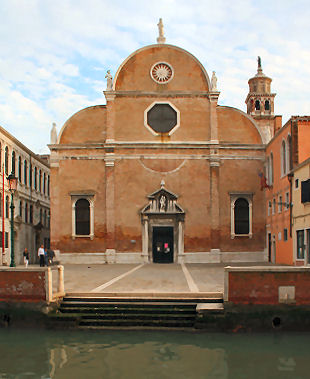
The brick façade facing the square and the canal is
early Venetian Renaissance and influenced by the work of Codussi. The
façade is by Sebastiano Mariano da Lugano, built 1507-14, as are the five crowning statues, probably.
The statues are, from the top, the Redeemer, John the Baptist, the Virgin, and the
prophets Elijia and Elisha. The last two are considered to be the founders
of the Carmelite order. The doorway has an unusual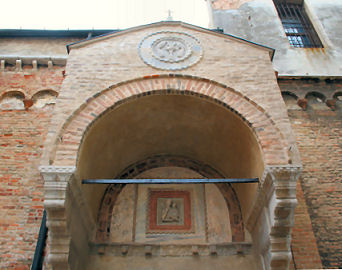 double pediment. double pediment.
The
side entrance on Calle de la Scuola with its very projecting canopy (see
right) is the original 14th-century façade and features Byzantine
palm-leaf detailing. It was restored in 2006 by
Venice in Peril. Interior
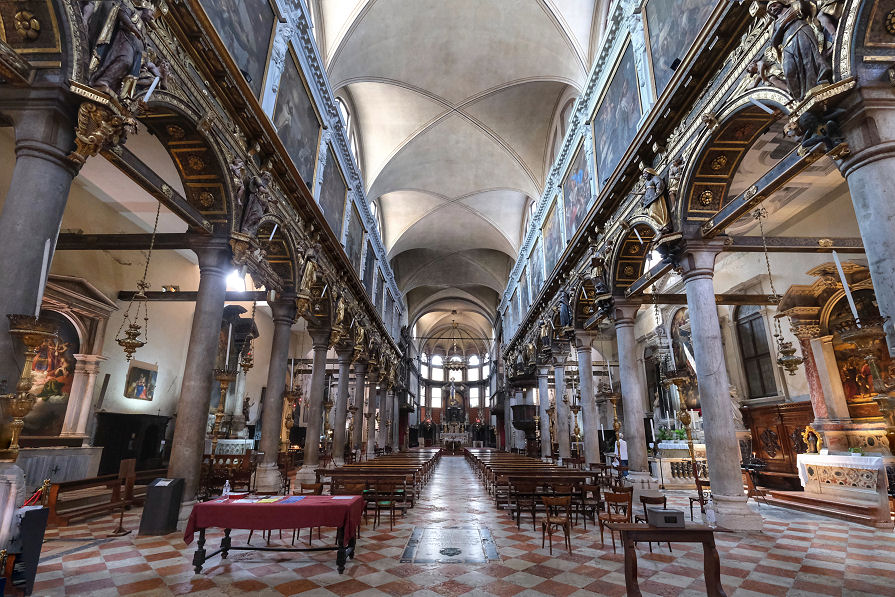
The form of the interior dates from the original 14th-century
Gothic building, but most of the decoration is later. The impression on
entering is of vast length. There are twelve bays down each side of the
nave, with
gilded statues in each of the spandrels, much gilding of the arches, and a frieze of
24 scenes of Carmelite subjects, painted from 1666 to the mid-1700s by Baroque painters,
including Giovanni Antonio Pellegrini, Gaspare Diziani, Girolamo
Brusaferro and Pietro Liberi. There are four altars in each aisle.
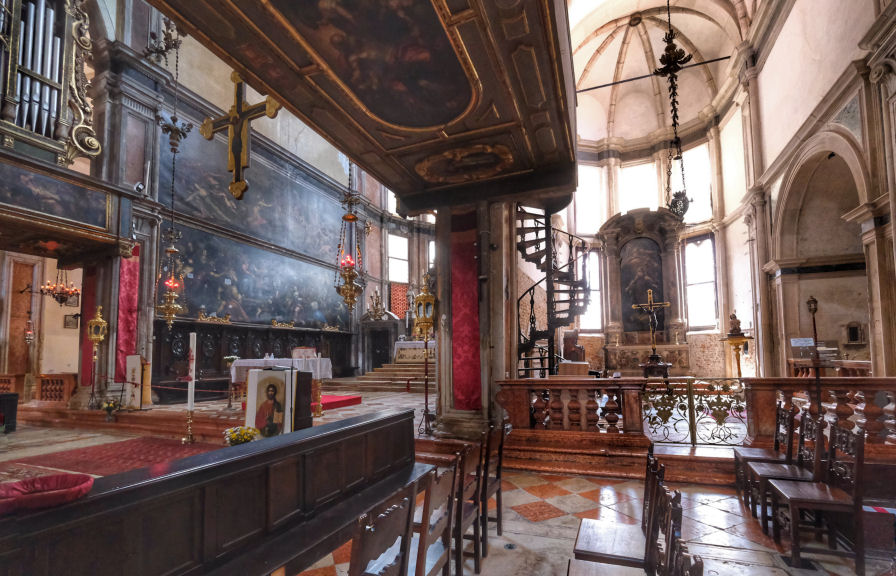
The church has no transept but
has odd big singing/organ galleries suspended
in the bays either side of the presbytery. The apse retains something of the
appearance of the 14th-century church and the sacristy has 14th-century
fresco fragments.
Art highlights
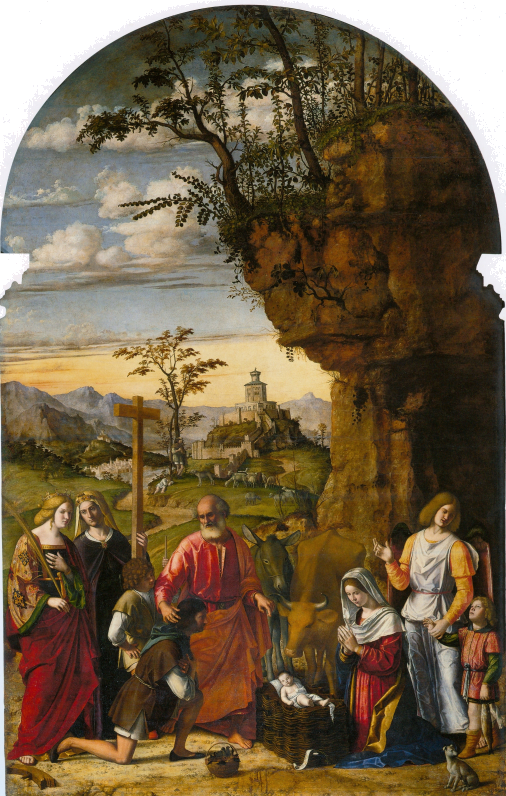
The second altar on the right has a 1509 Adoration of the
Shepherds by Cima da
Conegliano (see below right) which is one of his best, with the figures not looking
like shop dummies, as his so often do. It's also unusual in including Tobias and
the Angel amongst the attendant saints. The dog bears a striking
similarity to the one in Titian's Tobias and the Angel, now
in the Accademia. It doesn't quite fit its frame.
The third altar on the
right is the only one decorated up into the dome above, with a sparkling
fresco depicting Angels by Sebastiano Ricci from 1709. The
altarpiece here is by Pase Pace from 1594 and depicts The Virgin Giving
the Scapula to Saint Simon Stock.
The fourth altar, the Altare dei Compraven di Pesce
(fishmongers) has an early Presentation by Jacopo Tintoretto from
1546/48, which was restored in 2001.
Behind the high altar is a copy of the central
part of Titan's famous Assumption from the Frari, made by a painter called
Tagliapietra in 1856. Hanging above the altar is a painted wooden crucifix
said to be by Paolo Veneziano.
In the left hand aisle the second altar has Lorenzo Lotto's Saint Nicholas in Glory,
with Saints John the Baptist and Lucy, painted for the Scuola dei Mercanti
in 1529
and still in its original Istrian stone frame. It was Lotto's first public
commission in the city of his birth. On a visit in October 1891
the art historian Bernard Berenson, his wife Mary, and their friend Enrico
Costa washed this painting 'at the invitation of the sacristan', it having
been 'invisible under candle-grease, dust and cobwebs' according to Mary. The effect of Saint Lucy's
eyes floating above the chalice at her feet is very odd and frog-like. Saint George
fights the dragon in the impressive Flemish-looking landscape below.
To
the right of this painting, over the confessional, is
the early, small and
quite-recently-restored Holy Family with the Infant Saint John,
attributed to Veronese, which was previously in the church of
San Barnaba.
Further along is a deep side chapel with one
of those dressed up full-size Madonna and Child dummies on a big
canopied gold throne surrounded by masses of gold putti. It seems to
attract much local veneration.
The last altar on the left has Saint Albert by Pietro Liberi
from before 1664.
Ruskin wrote
A most interesting church, of later thirteenth century work, but
much altered and defaced. Its nave, in which the early shafts and capitals
of the pure truncate form are unaltered, is very fine in effect; its
lateral porch is quaint and beautiful, decorated with Byzantine circular
sculptures, and supported on two shafts whose capitals are the most
archaic examples of the pure Rose form that I know in Venice.
Cloisters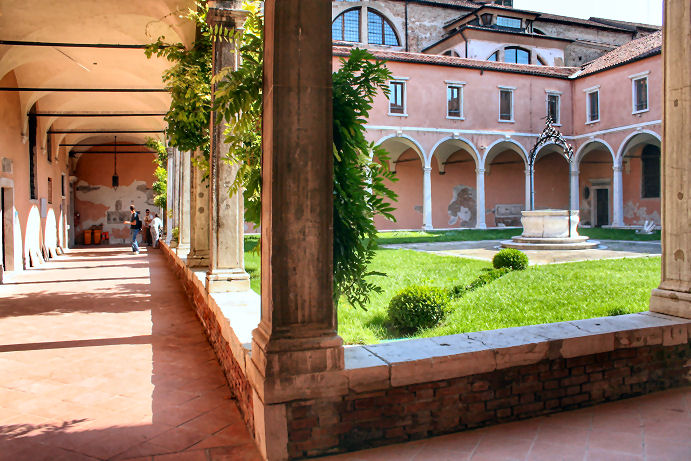
The cloister of the former monastery (see right), which was rebuilt in the mid-17th
century
and suppressed in 1810,
has an entrance to the right of the façade. The wellhead in the centre is
dated 1762 and has the Carmelite crest.
Campanile 66m (217 ft) electromechanical bells
The 1290 original is visible on Barbari map. It was damaged by earthquakes
in 1347, 1410 and 1511, demolished in 1511 and rebuilt taller in 1520. This
one began to lean as the foundations subsided and was straightened in 1688 by Giuseppe Sardi.
The method by which he achieved the straightening involved digging away at
the brickwork on the three sides away from the tilt and wedging wood into
the holes. He then dissolved the wood away with strong acid and the tower
tilted back. At this time the campanile was also topped by a small octagonal temple with
a bronze statue of the Virgin of Mount Carmel. The current statue is actually a
copy made in 1982 by Romano Vio after the original was struck by
lightning in 1979. When lightning struck the campanile, in 1756, the monks
ringing the bells at the time were so terrified they fled in panic and one
of them hit his head against a wall and died.
At the base of the campanile is the Orto del
Campanile, a community garden now growing fruit and veg,where previously
there was a dump.
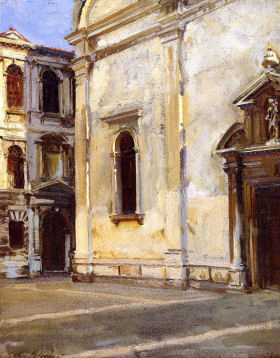
The church in art
Santa Maria del Carmelo and Scuola Grande dei Carmini, a
typically cropped oil painting by John
Singer Sargent (see right) shows the façade stuccoed over.
Sickert's oil painting The Church of the Carmine, now in the
Ashmolean, is from a viewpoint just a
little to the left of mine for the photo above, and merely trims off the
top of the façade. It too shows the façade stuccoed.
Opening times
Monday - Saturday
8.30 - 1.30 and 2.30 - 7.30
Sunday 8.00 - 12.00 and 6.00 - 7.30
This church began appearing on
Chorus
leaflets with the opening times below, but the ones
above are the ones still posted on the door and the church is not on the
Chorus
website..
Monday - Saturday
10.30 - 1.30 and 2.30 - 5.00
Sunday Closed
The Scuola
has it's own entry now on my
Scuole page.
Vaporetto Ca' Rezzonico or San Basilio
map
|
|
|
Le Eremite
Giovanni Battista
Lambranzini 1693
|
|
History
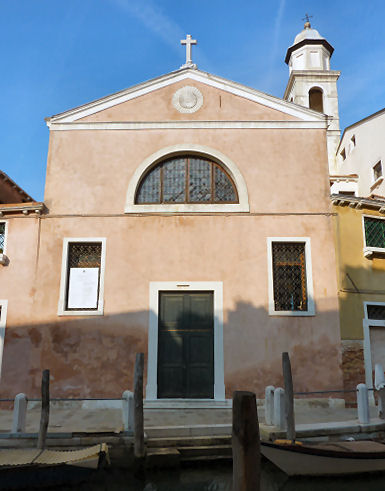
Built in 1694 by Giovanni Battista Lambranzini
(who was also responsible for the nearby
Santa Margherita and the
modernization of the interior of
Santa Marta) for observant Augustinian nuns, and
paid for by Santo Donadoni and dedicated to Jesus, Mary and Joseph.
The widow of Doge Giovanni Corner lived here until her death in
1729.
The complex was suppressed in 1810, at which time 38 nuns were
resident. Canossian nuns
moved in in 1863, and they remain here. The complex has been used as a teacher-training college,
by various schools, for language teaching, and now as student and tourist
accommodation.
The church was restored in late 1990s by
Venice in Peril as it
had suffered severely from damp. The work was described as 'stabilising
and consolidating the altars'. Also at this time the Fondation Jean-Barthélémy,
and others, paid for the restoration of paintings in the church in memory
of the painter Marie Thérèse Krafft, who had lived nearby. This restoration
work, on four wall paintings by Francesco Pittoni of The Miracles of St
Augustine, was completed in 2002. More restoration work took place in
2008/9.
When I wrote to the
Istituto Canossiano in
2010 asking if I could have a look inside I was told that that 'at the
present the church is being restored, and is not possible to enter'. A
visitor in 2014 was told the same thing.
Interior
Described as 'rich and
sumptuous' in
Franzoi’s Le Chiesa di Venezia,
the church consists of an aisleless
nave, divided in two by the altar with an enclosed choir
behind for the nuns. There are ceiling paintings,
including The Crowning of the Virgin
by Niccolò Bambini, returned now after
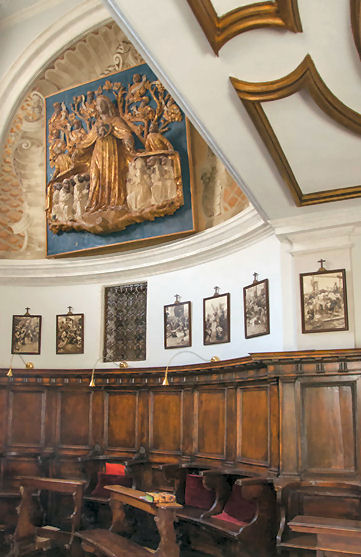
recent restoration, and 15th century wooden choir stalls
with an unusual gilt and polychrome relief carving of The
Madonna of the Misericordia
in the choir
behind the altar (see photo
by Val de Furrentes
right).
Relics
Relics kept here included a thorn from the Crown of Thorns (on which
it is said blood appeared on Good Friday), the hand of Saint Juliana and
several bodies of saints taken from Roman catacombs.
Campanile
13m (42ft) no bells
Has an eight-sided
budino (pudding) shaped dome.
Vaporetto
San Basilio
Opening times Always closed. Which after all that expensive charity-funded
restoration work seems something of a waste and a shame.
map
|
Gesuati
Giorgio Massari 1726-43
|
|
History
Monks from the mendicant order of Clerici
Apostolici Sancti Hieronymi (Apostolic Clerics of Saint Jerome)
founded in the 14th century by Giovanni Colombino from Siena established themselves
here in 1392. In 1423 they built an oratory and cloister dedicated to
Saint Jerome. (They had previously occupied the nearby church of Sant’Agnese.) A proper church and monastery were built here by the Poor
Gesuati order (as they now called themselves) from 1494, which was consecrated 1524
and dedicated to Santa Maria della Visitazione.
The Zattere fondamenta
derives its name from the order.
The, always contentious, order was suppressed in
1668 by Pope Clement IX and in 1669 the Dominicans bought the complex here
at auction, thereby helping to fund the wars against the Turks. After
initially approaching Andrea Musalo, who died, they got Giorgio Massari
to build the present, much larger, church, beginning work in 1726, to the
east of the old church, and finishing it in 1743. Massari also converted
the old Gesuati church (now
Santa Maria della Visitazione)
to a library.
In the foundations of the new church was placed a
medal, designed by Massari, on one face celebrating the dedication of the
church to the Vergine del Rosario and on the other commemorating, with his
arms, Pope Benedict XIII, a Dominican who had been trained at
San Domenico di Castello and who, on
becoming pope had called for the refinement and elaboration of the feast
of the Rosary.
The new church became a parish church when the order was
suppressed in 1815, to replace the nearby suppressed and closed churches of
San Vio
and
San Gregorio. The monastery to the left of the
church, which become a boys' home after suppression, is now the home of the
Istituto Don Orione.
The church
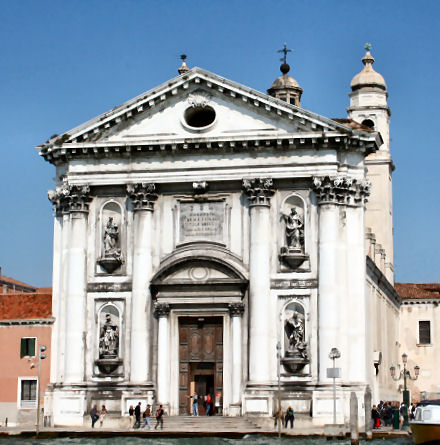
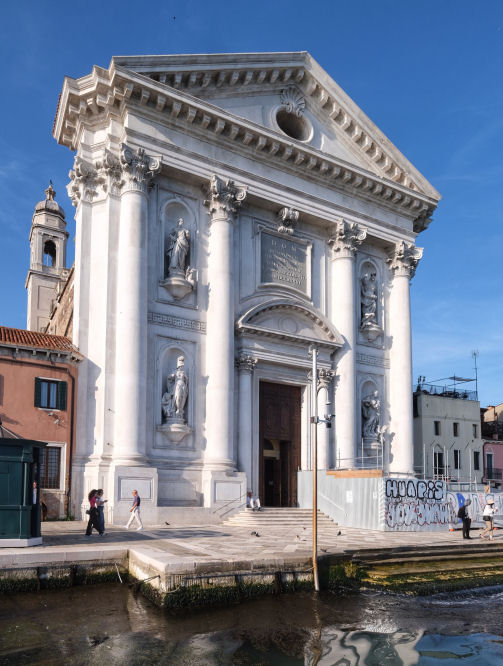
This was the architect Massari's first major commission in
Venice. The niches on
the façade (a heavier and more theatrical reflection of the façade of the
Redentore church opposite) contain large statues depicting the four
virtues. A stone relief of The Dead Christ Supported by Two Angels set
into the side wall of the church (seen to the right in the photo right)
may be from the original church.
Interior
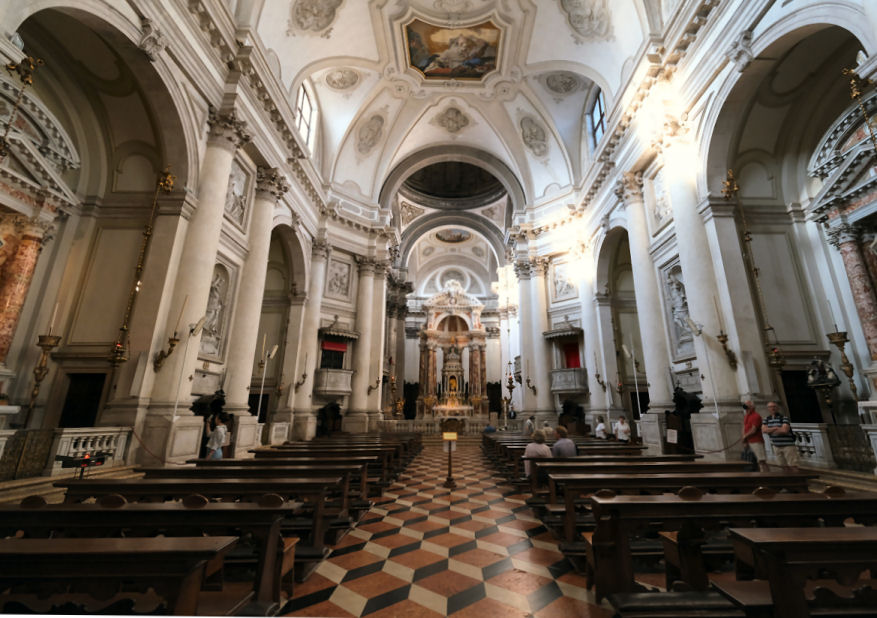
The
interior, like the façade, is modelled on the
Redentore. It consists of an
aisleless nave with three connecting side chapels each side, full
of exceptional 18th-century art, with a window above each arch. The effect of the walls and detailing is
pale grey, getting darker for the domed chancel, with it's unplain
tabernacle by Massari.
The
sculptural work - narrative scenes, apostles and Old Testament figures -
is by Giovanni Maria Morlaiter.
Art highlights
This church is a
real treat for fans of Giambattista Tiepolo, who made forty painting here
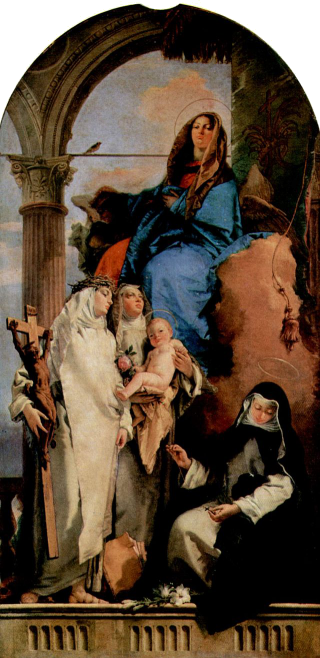
over the span of a year, from September 1738, including many in grisaille. Amongst his best is the altarpiece in the first chapel on the
right depicting the Virgin and Three (female Dominican) Saints
(see right) which was finished by December 1739, but not
installed until 1748. The three female Dominican saints are Catherine of
Siena, Rose of Lima and Agnes of Montepulciano. Tiepolo also painted the
three
Dominic-related ceiling paintings, well worth the neck ache, or the easier
perusal using the handily provided (and precisely shaped) floor-standing
mirror. They are painted in fresco, not oil on panels as is more usual in
Venice. Near the entrance is The Ascension of Saint Dominic, nearest
the altar is Saint Dominic's Vision of the Virgin and in
the centre is the large Institution of the Rosary. They were all
also finished by 1739. The smaller grisaille paintings dotted round the
ceiling are said to have been designed by Tiepolo but executed by
his studion. In the choir is another ceiling painting by Tiepolo, of
David and the Angel
Also two by Giambattista Piazzetta (in the
following, second and third,
chapels on the right), one being Saint Louis Bertrand with Saints
Vincent Ferrer and Hyacinth, the other The Miracle of Saint Dominic
at Soriano - a small work in a large marble frame. And there's a good late one by Sebastiano Ricci, in the
first chapel on the left, depicting the Dominicans Pope Pius V, Saint
Thomas Aquinas and Saint Peter Martyr
from 1732-3.
In the third chapel on the left is an over-restored Tintoretto Crucifixion
of c. 1565, which came from the nearby church of
Santa
Maria della Visitazione. It was in a poor state then and
the Dominicans had it restored by Piazzetta in 1743 for its movement here. The foreground is full of
emotional Marys.
Campanile 21m (68 ft) electromechanical bells
Also by Massari, with a matching parallel tower.
The church in art
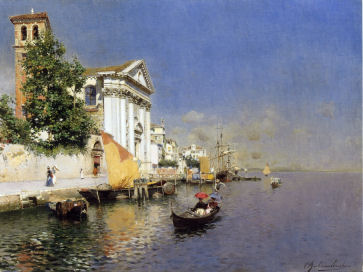
The church dominates the right foreground of The Giudecca Canal with the Zattere
by Guardi.
The Giudecca by
David Roberts. Le Quai des Zattere by Léonce Cordier (1873).
Also watercolours by John
Singer Sargent and John Ruskin.
Santa Maria del Rosario, known as Chiesa dei Gesuati, by Rubens Santoro (see
below right) has bizarre truncation of
the church and
the wrong campanile.
H.Taine wrote (in Italy: Florence and Venice 1869)
...on the ceiling a pretty piece of boudoir painting in the shape of
trim, rosy and bare legs; - in brief a work of frigid luxury and costly
magnificence. The Italian eighteenth century is still worse than ours. Our
works always show some degree of moderation because they preserve some
degree of finesse; but theirs plant themselves triumphantly on the
extravagant.
As Taine was French the last statements provoke a wry
smile, at the very least.
Opening times
On a laminated sheet screw-fixed to the
scaffolding mentioned below the new times are:
Monday to Saturday: 8.00 -
7.00
Sundays and Holy days: 9.00 - 12.00 & 5.00 - 7.00
which seem to be replacing the usual
Chorus hours of:
Monday to Saturday: 10.30 -
1.30 and 2.30 - 5.00
Sundays: closed
A Chorus
Church
Vaporetto Zattere
map
|
|
|
Ognissanti
1505-1520
|
|
History
Founded by Cistercian nuns from the convent
of Santa Margherita on Torcello who moved here because it was a more
salubrious location. They brought their own paintings with them, amongst
them one by Palma Giovane. They probably occupied an existing house initially,
having a small wooden church built for them in 1472. Their finances
would've improved after they acquired a miracle-working image of the
Virgin.
The church was rebuilt enlarged from 1505 to 1520 and consecrated in 1586.
The length of time taken was probably the result of the sisters' poverty
causing slow and often-interrupted work.
The complex
was suppressed by the French in 1806 and stripped of its art. In 1820 the
convent became a girls' school, and then an old people's home later in the
19th century. It was a hospital after this, until the mid-1990s, and is now part of the Universita Ca'Foscari.
Interior
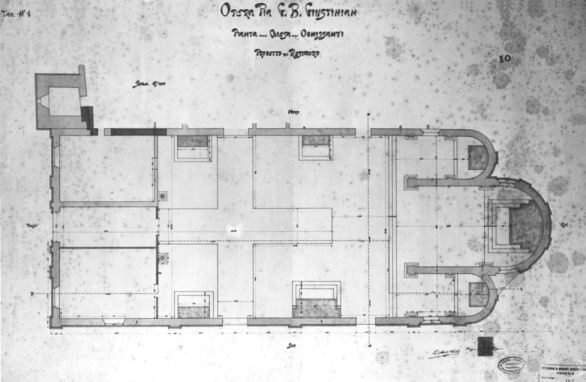
Aisleless with a ceiling divided into compartments where small
paintings might be set, but aren't, this is a small and plain and very-used
convent church with a big nuns' gallery at the back taking up almost half
the church’s length (see photo below right) with two altars each
side of the nave.
The presbytery and its two flanking side chapels have frescoed
ceilings, and for these alone I'd recommend a visit. The presbytery
frescoes were commissioned on the 13th March 1673 from Agostino Litterini,
who was helped by Giacomo Grassi, from Bologna. In the apse is The Last
Supper, in the vault is The Glory of Paradise. The
flanking chapels' ceilings are assumed to be by the same artists, as the
look very similar in style. The left-hand chapel, which belonged to the
Michiel family, has God the Father in the apse and The Four
Virtues in the vault. The Battaglia Chapel, on the right, has The
Virgin in Glory and two angels bearing flowers and fruit.
Lost art
Paolo Veronese's congested (it features fifty figures) and spectacular
Coronation of the Virgin, of 1583, from the high altar here,
is now
in the Accademia, in the new Room X dedicated to Veronese. It's dating coincides nicely with the church's
completion in 1586. Attributions to Veronese’s workshop are common but
there are preparatory studies by the man himself at Christ Church Oxford and elsewhere. He was also commissioned to paint organ shutters for
this church around the same time. These show The Adoration of the Magi
and The Fathers of the Church and are now in the Brera in
Milan, the city which Napoleon intended to make the capital of his new
Kingdom of Italy, primarily to annoy the Venetians.
A Visitation painted by Carlo Ridolfi is in
storage in the Accademia. A Baptism of Christ by Giacomo Alberelli is
lost. As are a large painting by Pietro Muttoni, The Slaughter of the
Innocents by Pietro Liberi and a work called Morto Riuscitato
by Carlo Sacchi.
The church in art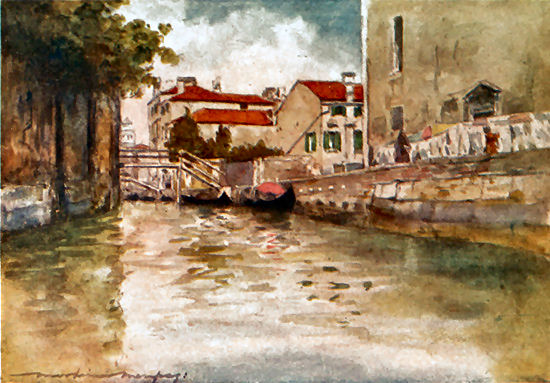
Rio e Chiesa degli Ognissanti by Mortimer Menpes (see right)
The church on TV
An episode of the German TV series based on Donna Leon's Brunetti novels,
called
Beastly Things, features the gateway pictured (above right) as the
entrance to a fictional hospital.
Campanile 40m (130ft)
manual bells
Opening times
9.30-12.30 and 5.30 - 7.00(?)
Vaporetto San Basilio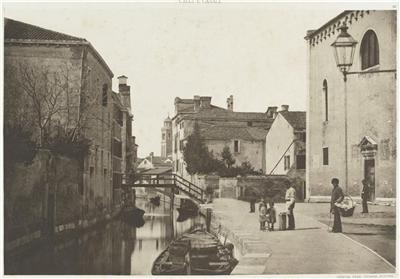
map
|
|
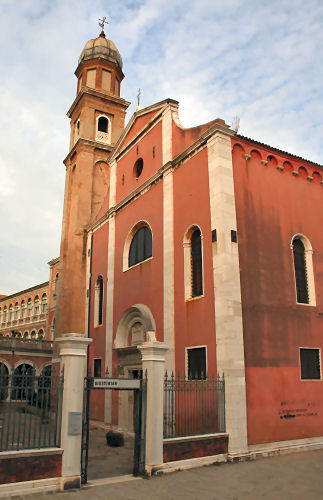
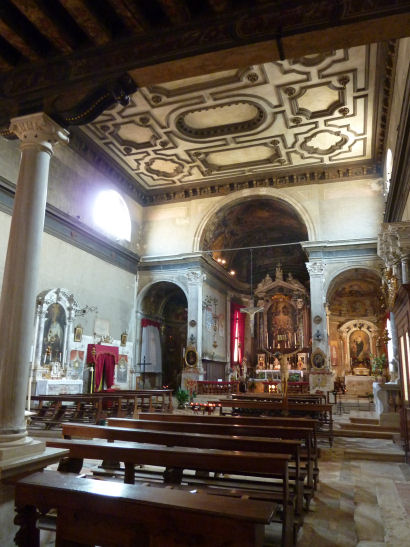
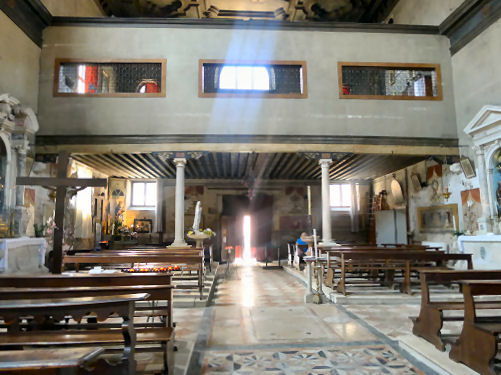
Photo above by David Orme
|
Pio
Loco dei Catecumeni
Giorgio Massari 1727
|
|
|
|
History
The Catecumeni confraternity was founded in 1557 and had previously been
housed in the churches of San Marcuola
and Santi Apostoli. It moved here in 1571, building on land provided by
Andrea Lippomano, maybe moving here to help with the increased number
of patients at the hospital of the Incurabili after the battle of Lepanto.
The institution cared for slaves and prisoners of war captured during foreign
campaigns. It's underlying purpose being to convert 'infidels' (Muslims
and Jews) to Christianity ready for
baptism and subsequent citizenship. This task had previously been
undertaken by families, who would take in potential converts and guide
them through the process.
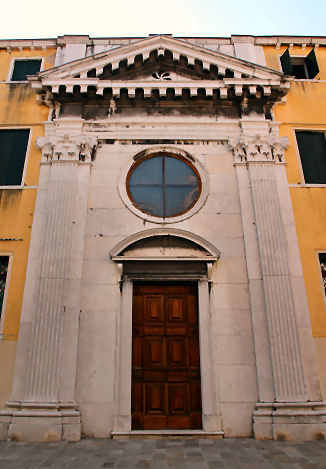
The complex was rebuilt in 1727 by Massari (the year after he completed the
Gesuati) basing
it on Palladio's Zitelle, with a
central church (San Giovanni Battista) flanked by two blocks of
accommodation. It later became a nursery school, but now houses the Istituto Suore Salesie.
Opening times
In August 2021 I received a
report of this church being found open with nuns in evidence. Further
reports welcomed.
Vaporetto Salute
map
|
|
 |
Saint George's
Luigi Marangoni 1892
|
|
History
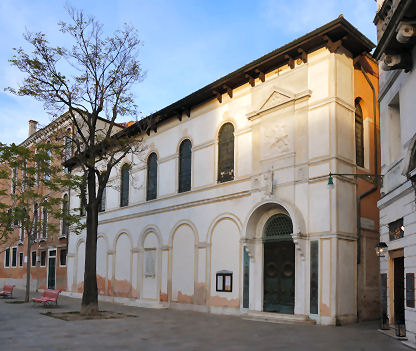
This church was converted from a warehouse previously
belonging to the Venezia-Murano Glass company and bought by Sir Henry
Layard. He donated it to a committee which had been set up to establish a
permanent
English Church in
Venice. The church opened in 1892, built to a design by engineer Luigi
Marangoni, with sculptures by Napoleone Martinuzzi. It contains the
tombstone of Consul Joseph Smith, which was moved here from the Protestant
burial ground on the Lido, where he had been buried, in 1968. There's also a
window commemorating Robert Browning who allowed Anglican services to be
held in the Ca’ Rezzonico during the time he lived there. It is one of
seven stained-glass windows here recently restored with the help of Venice
in Peril.
The church was closed from 1935-45 and then after 1945
reopened as a garrison chapel. Public services were later resumed for the
Summer season. During his chaplaincy of 1967-74 Canon Victor Stanley
resumed year-round services.
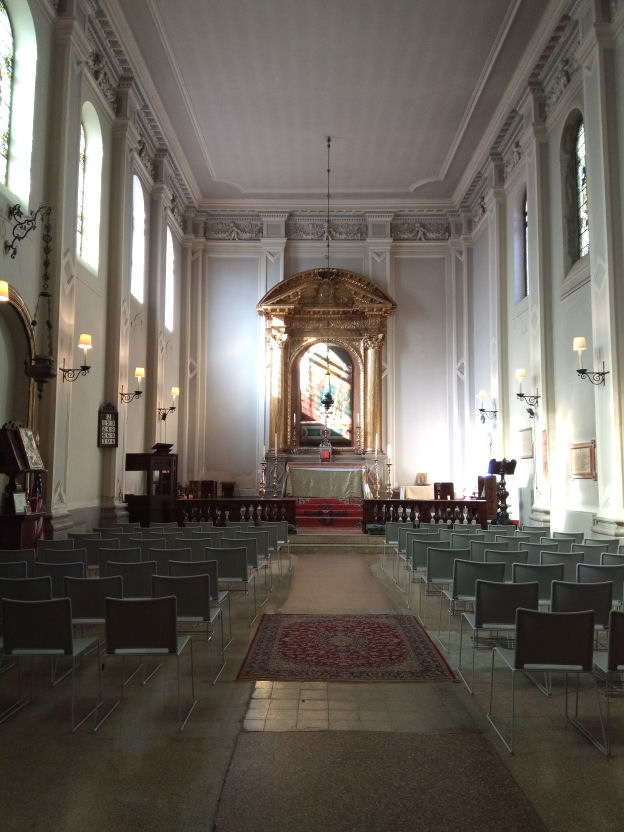
On the 30th May 2019 the pews in St George's were
removed to make the space more flexible. Tasteful grey stacking chairs will now be used
for services (see left) and so the church can now also be used for
exhibitions.
Interior
The church has a 19th-century copy of
a 16th-century sacra conversazione by Giovanni Buonconsiglio, the
original once
having hung in in the nearby church of
Spirito Santo.
It depicts Christ the Redeemer with
Saints Jerome and Saint Liberalis of Treviso, with Saint Liberalis in
the copy here transformed into Saint George, with Liberalis's usual flag of a
white cross on a red background reversed to the red-on-white of Saint
George.
Opening times
Services every Sunday at 10.30am
Vaporetto Accademia
map
|
Salute
Baldassare Longhena
1631-87
|
|
History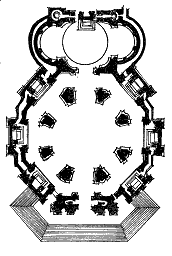
The
original monastery and church on this site, dedicated to The Holy Trinity
(Santissima Trinità),
was given by Venice to the Teutonic Knights in 1256 in gratitude for their
help in the war against old rivals Genoa. This complex is shown on the
Barbieri map of 1500 (see below). It also housed the Scuola della
Trinità for which Tintoretto painted his famous sequence of Old
Testament scenes, three of which are now in the Accademia. Suppression by Pope Clement XVI followed in
1592 and the complex returned to the patriarchate of Venice.
This original complex was demolished in order that this church be built to
hasten and celebrate the end of the last great plague of 1630-31 which had
taken 46,000 people, 30% of Venice’s population. The pestilence had supposedly been
brought from the quarantine island of San Clemente by a carpenter who
lived in the nearby parish of Sant'Agnese. Santa Maria della Salute
means Saint Mary of Health - the Virgin was thought to have had a hand in
saving the Venetians. The commission was prestigious and a competition
was held, among its conditions were that the church be flashy
but not too expensive. Eleven proposals were reduced to two, the loser of
these being a more traditional design by Smeraldi. The twenty-six year old
Longhena’s winning design took a Palladian base and made something freshly
baroque and very theatrical. Longhena had studied with Scamozzi, who had
himself collaborated with Sansovino and Palladio. Building took 30 years (a wooden oratory was used
in the meantime) with the square in front
laid out in 1681. Longhena died in 1682 and Gaspari finished his work.
Consecration took place on the 9th of November 1687
The church’s dome with its crowds of angels and its famous huge volutes
cannot be said to make a small impression. And the building needed to
impress, as it formed the centrepiece of the grand annual ceremony where
the doge crossed the canal on a specially-built bridge of barges and
processed through the central arch to give thanks for Venice’s
deliverance. The ceremony continues to this day, without a doge, but with
crowds buying sweets and candles and streaming across the rickety
structure. In the 1930s it did collapse, with Sir Osbert Sitwell on it.
The church long symbolised Venice’s triumph over adversity and its
republican strength, just as its silhouette now symbolises Venice in
almost every film and TV programme that gets made about the city.
The church
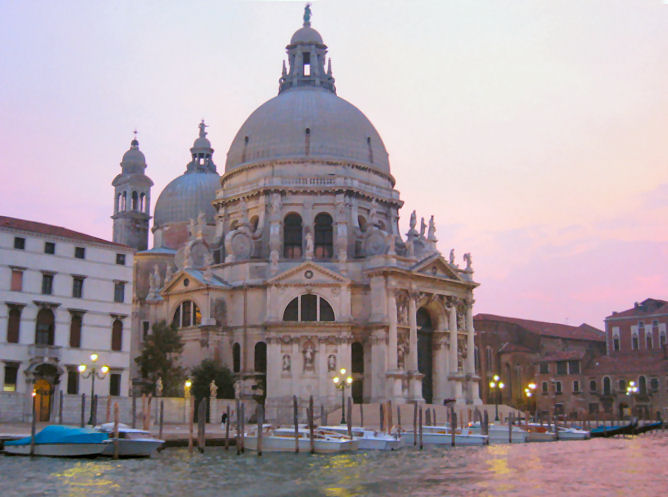
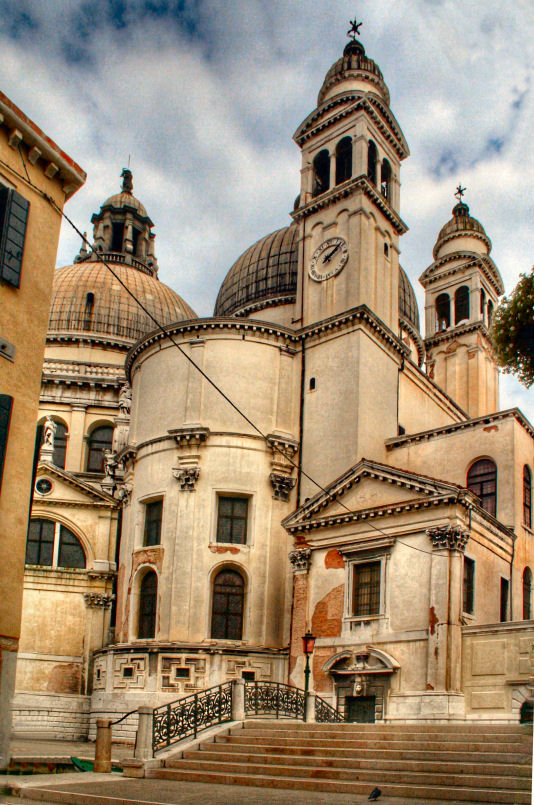
An extravagant display, made up of eight Palladian façades, with the
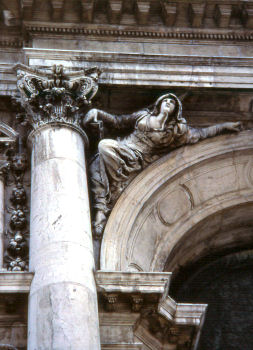
grandest facing onto the Grand Canal, up thirteen steps. Huge buttresses with orecchioni
(big ears) support the drum of the dome and lots of statues of saints
and angels. The lantern on top of the dome supports a statue of the Virgin
blessing the city. Behind there's the smaller dome over the sanctuary and
two relatively delicate campanili.
Interior
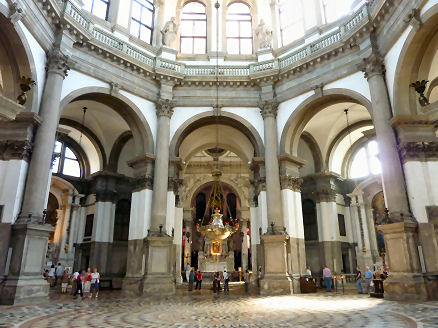
The interior is impressive but restrained, given the church’s exuberant
exterior – a quite plain octagonal space with an ambulatory and
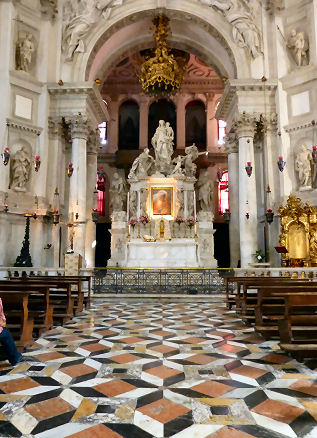
six radiating chapels. The high altar is by Longhena. The paving is said
to be inlaid with 33 roses symbolising the 33 years of Jesus's life.
Art highlights
Many works by Titian, all taken from the
demolished church of
Santo Spirito in Isola,
following Pope Alexander
VII's suppression of the Augustinian order.
Supposedly Titian's first altarpiece, Saint Mark Enthroned with
Saints Sebastian, Roch, Cosmas and Damian, was painted
during the plague year of 1510-11. The Pentecost
altarpiece is later, having been commissioned in 1529/30 and installed
over Santo Spirito's high altar in 1541, it had to be replaced with a
second version is 1545-6 as the original's paint deteriorated rapidly. The three ceiling
panels depicting Old Testament stories which are now in the sacristy
were painted for a commission originally given to Vasari. The skies in
all three date to 17th century repaintings of lost pigment, with added clouds. They depict
The
Sacrifice of Isaac, Cain and Abel, and David and Goliath. The
last one was removed and restored in 2010 after water sprayed by firemen
tackling a fire at the Seminario next door leaked in though the roof.
Also eight portrait roundels in the ceiling of the choir depicting
The Four
Evangelists and The Four Fathers of the Church.
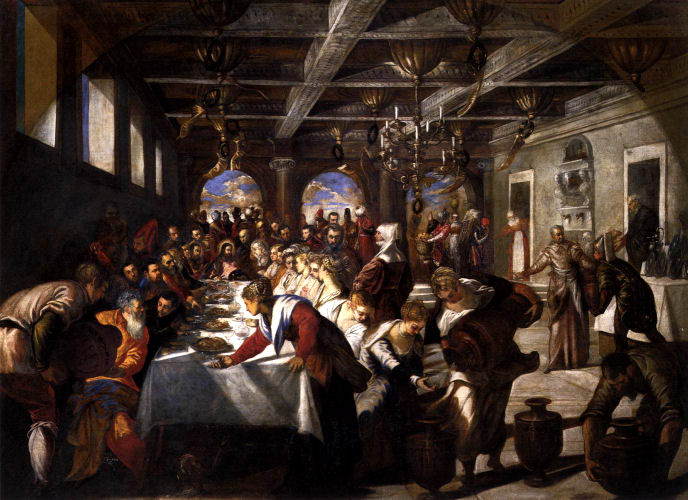
There's
also a huge Jacopo Tintoretto
Marriage at Cana in the sacristy (see above) dated 1561 it was painted for the
refectory of the Crociferi, the complex previously on the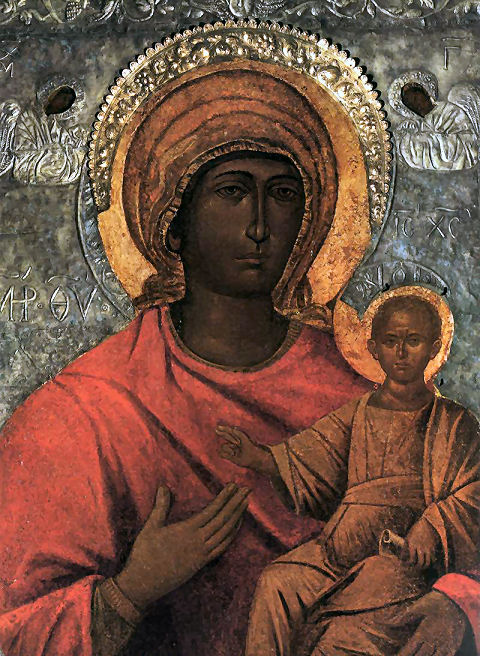 site of the
Gesuiti,
and was moved to the sacristy here in 1659 after the
Crociferi
order
was suppressed in 1656. It's the only feast scene that
Tintoretto painted for a refectory, despite his being responsible for at least
nine Last Suppers. Jesus is oddly far in the background, at the
end of the table, but framed by the window and haloed with a nimbus. It was restored in 2017, during which work it
was discovered to have been painted in egg tempera rather than oil, and
without the usual preparatory layer of gesso. site of the
Gesuiti,
and was moved to the sacristy here in 1659 after the
Crociferi
order
was suppressed in 1656. It's the only feast scene that
Tintoretto painted for a refectory, despite his being responsible for at least
nine Last Suppers. Jesus is oddly far in the background, at the
end of the table, but framed by the window and haloed with a nimbus. It was restored in 2017, during which work it
was discovered to have been painted in egg tempera rather than oil, and
without the usual preparatory layer of gesso.
A Byzantine icon of
The Virgin Mesopanditissa (see right) said to have been
painted by Saint Luke and to have worked miracles, but actually from the 12th or 13th
century, was brought here from Candia (Crete) in 1669 after the fall of the
island
to the Ottomans. It's set into Longhena's somewhat congested
high altar.
Campanile 48m (156ft) electromechanical bells
Two towers, but only one of them has bells.
Edwardian suicides
In 1908 Jean Cocteau wrote a poem called Souvenir d'un soir d'automne
au jardin Eaden, which tells of an argument between Cocteau's
companion on his trip to Venice and a young American. The quarrel, which
took place in the
Garden of Eden,
lead to the friend shooting himself on the steps of the Salute, which
was a not-unusual event at the time, it seems. Francois Mauriac, writing
in Le Mal many years later, mentions this event and says of the
thirteen steps of the Salute: 'One cannot even count all the young men who have
chosen to die there!'
Ruskin wrote
One of the earliest buildings of the Grotesque Renaissance,
rendered impressive by its position, size, and general proportions. These
latter are exceedingly good; the grace of the whole building being chiefly
dependent on the inequality of size in its cupolas, and pretty grouping of
the two campaniles behind them. It is to be generally observed that the
proportions of buildings have nothing whatever to do with the style of
general merits of their architecture. An architect trained in the worst
schools, and utterly devoid of all meaning or purpose in his work may yet
have such natural gift of massing and grouping as will render all his
structures effective when seen from a distance: such a gift is very
general with the late Italian builders, so that many of the most
contemptible edifices in the country have good stage effect so long as we
do not approach them. The Church of the Salute is farther assisted by the
beautiful flight of steps in front to fit down to the canal; and its
façade is rich and beautiful of its kind, and was chosen by Turner for the
principal object in this well-known view of the Grand Canal. The principal
faults of the building are the meagre windows in the sides of the cupola,
and the ridiculous disguise of the buttresses under the form of colossal
scrolls; the buttresses themselves being originally a hypocrisy, for the
cupola is stated by Lazari to be of timber, and therefore needs none. The
sacristy contains several precious pictures: the three on its roof by
Titian, much vaunted, are indeed as feeble as they are monstrous; but the
small Titian, "St. Mark, with Sts. Cosmo and Damian," was, when I first
saw it, to my judgment, by far the first work of Titian's in Venice. It
has since been restored by the Academy, and it seemed to me entirely
destroyed, but I had not time to examine it carefully.
E. M. Forster wrote
...and then came Venice. As he landed on the piazzetta a cup of
beauty was lifted to his lips, and he drank with a sense of disloyalty.
The buildings of Venice, like the mountains of Crete and the fields of
Egypt, stood in the right place, whereas in poor India everything was
placed wrong. ...but oh these Italian churches! San Giorgio
standing on the island which could scarcely have risen from the waves
without it, the Salute holding the entrance of a canal which, but for
it, would not be the Grand Canal!
A Passage to India
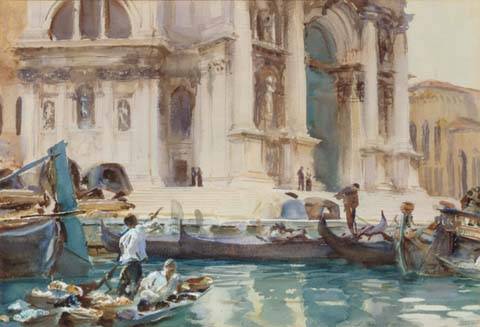
The church in art
Amongst the many views are all the usual suspects (Canaletto, Guardi, Marieschi,
Turner) but
perhaps the most famous are by Sickert and Sargent. They both had a thing
for oddly cropped views, like the one by Sargent (see right). Frank
Brangwyn painted the church too.
Bibliography
Andrew Hopkins Santa Maria della Salute - Architecture and
Ceremony in Baroque Venice Cambridge UP 2000
The church
in film and on TV
The Salute has become a bit of a cliché for use in establishing shots that say Look - it's Venice!
Amongst the most memorable scenes are the threesome having a picnic on the
steps in
The Wings of the Dove and the dome appearing mysteriously
over Katharine Hepburn's shoulder as she chooses shoes in
Summertime. (I
say 'mysteriously' because there are no shops anywhere near the church.)
Opening times
Summer 1st April - 31st October
9.00-12.00 & 15.00-17.30
The Sacristy (€10
timed ticket)
Tuesday afternoon: 14.00-15.30 & 16.40-17.30
Wednesday - Friday: 10.00-12.30, 14.00-15.30 & 16.40-17.30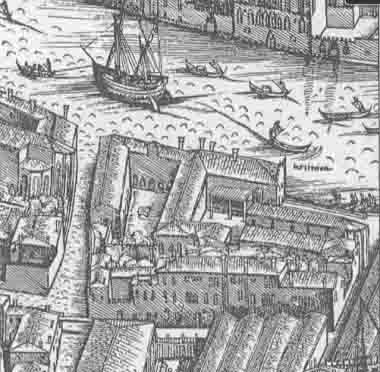
Saturday: 10.00-12.30 & 14.00-17.30
Sunday: 10.00-10.30 & 14.00-17.30
Winter 1st November - 31st March
9.30-12.30 & 15.00-17.30
The Sacristy (€10 timed ticket)
Monday - Friday : 10.00-12.00, 15.00-15.30 & 16.40-17.30
Saturday: 10.00-12.00 & 14.00-17.30
Sunday: 10.00-10.30 & 14.00-17.30
Update September 2023 Scaffolding still all up the
sides facing the Grand Canal, with advertising for expensive jewellery.
Also a danger you'll find the place closed.
Vaporetto Salute
map
website
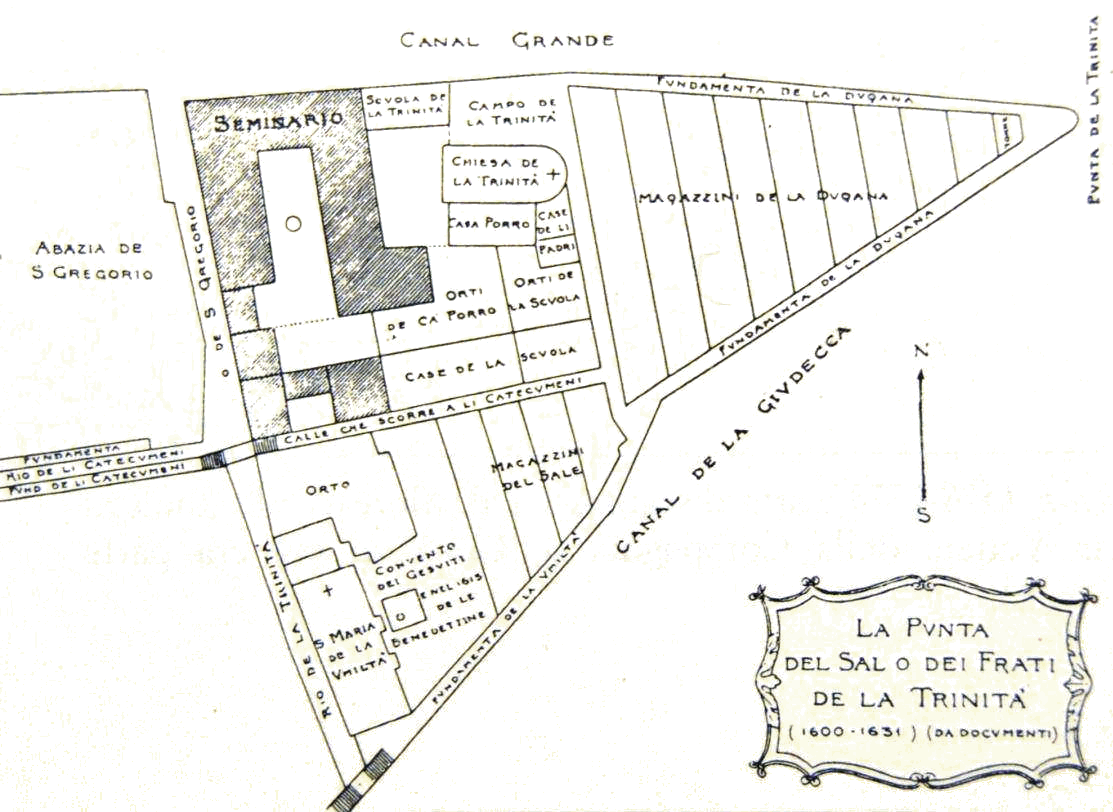
The Santissima Trinità complex,
demolished to build the Salute.
From the Barbieri map of 1500. The church is sideways on to the Grand
Canal and the seminary blocks are built on the canal and rio, as is also
visible in the 1631 plan below. |
|
|
|
 |
|
San Barnaba
Lorenzo Boschetti 1749-76
|
History
Founded in 809, the original church burnt down in 1105 and was rebuilt and consecrated
on the 6th of December 1350. The current church dates from 1749-76 and is by
Lorenzo Boschetti, a follower of Massari, being commissioned by
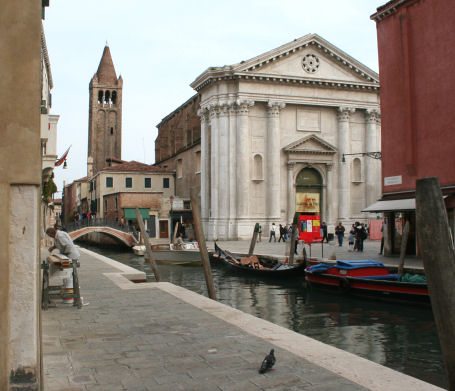
Marcantonio Grimani. Boschetti's façade is another
Greek temple front, based on Massari's nearby
Gesuati, but heavier, with
even beefier columns.
Art highlights
There are/were a couple by Palma Giovane. Also a ceiling fresco by Costantino Cedini, a
late-18th-century follower of Tiepolo, from Padua, who did similar work in
San Cassiano.
Lost art
A quite-recently-restored Holy Family with the
Infant Saint John (brought here from the (presumably now lost) Maddalena church in Padua in
1774)
which some, Bernard Berenson included, have attributed to Veronese, was
more recently moved to the
Carmini, where it is now confidently labelled as an
early
work by Veronese.
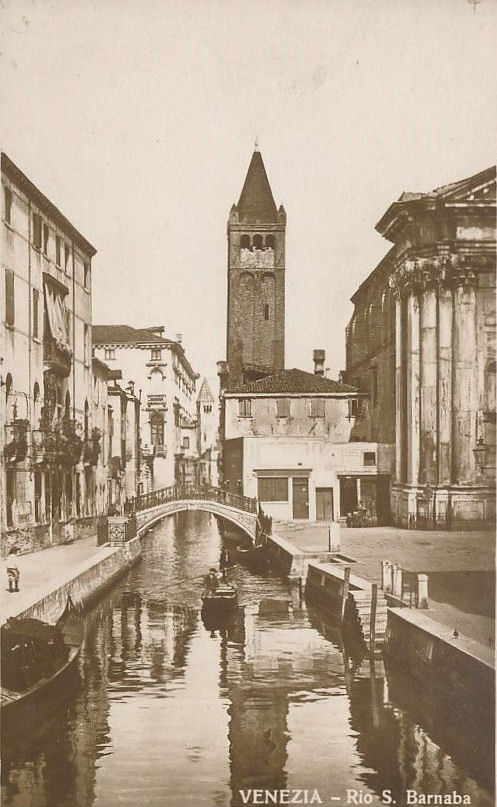 Campanile 35m (114 ft) manual bells Campanile 35m (114 ft) manual bells
Brickwork
with a pine-cone shaped steeple. The original 11th century tower was
rebuilt in Gothic style in 1350 and restored in 1882 by Lodovico Cadorin.
It looks to be in a poor state of repair.
The Barnabotti
The cheapness of the rents in the area around the church lead to its
colonisation in the 18th century by nobles who had ruined themselves
through extravagance, and who where thus called the Barnabotti, in honour
of the area. They were
supported by the state and their daughters were accorded begging
privileges.
The church in film
The church featured as a library in Indiana Jones and the Last Crusade - our hero
finds catacombs, rats and dead Crusaders under the floor and later emerges from a manhole
in the campo. Katherine Hepburn fell into the canal in
front of this church in
Summertime
and the shop where she finds the red glasses, and her late-life love
interest, is to the left of the façade.
The church in art
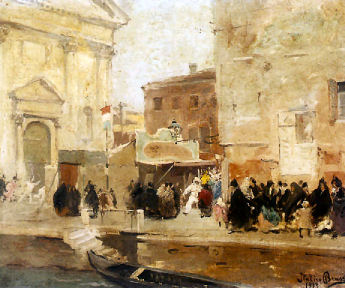
Maschere à San Barnaba by Italico Brass (see right)
the painter father of the famed ass-obsessed pornographer Tinto Brass.
There's also Sortie de
Messe à
San Barnaba by Julien Gustave Gagliardini (1912).
Opening times
Long deconsecrated, the church used to be mostly closed, but is currently
eternally open 9.30 - 7.30 daily due to a
'temporary' exhibition of models of Leonardo's
machines which has been here for many years now and shows no sign of
ever leaving. (Find
details
here.)
There's a lot
of scaffolding and display cases and stuff inside, though, which makes appreciation
of the actual fabric pretty much impossible.
Vaporetto Ca' Rezzonico
map
|
|
|
|
San Gregorio
Antonio di Cremona
15th century
|
|
History
Founded in 806 and given to Benedictine monks from
the abbey of Sant'Ilario on the banks of the lagoon,
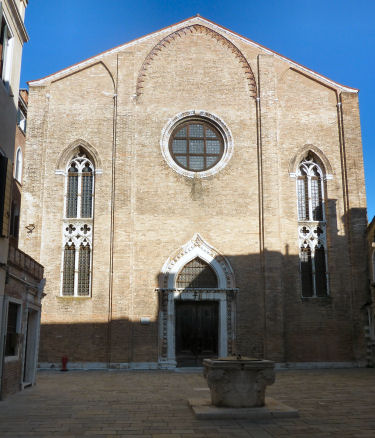
who founded an abbey here in 1160. The current church dates from the
mid-15th century and is by Antonio di Cremona. It's closely modelled on
the nearby church of the Santa Maria della
Carità with its three-part brick Gothic façade, but has
long since lost the finials that the façades shared, visible in the detail
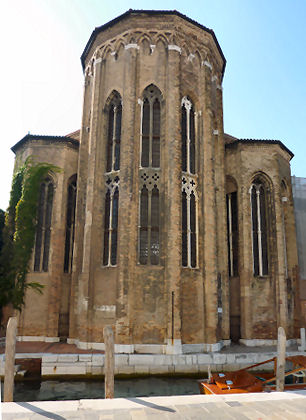
from the Canaletto painting (see below). Has a triple-apse
(see below right) facing onto a canal at the rear. Built into the
façade of the canonica to the right
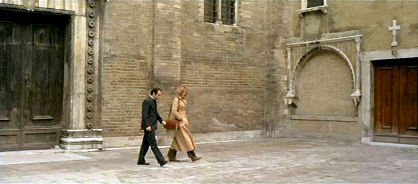
of the church’s façade
is an arch from a 14th-century funerary monument, visible in the film
still below. The skin of Marcantonio Bragadin, who had been flayed alive by the
Turks in 1571, was kept here in a wooden box in a column, before being moved to
San Zanipolo in 1596.
Palma Vecchio is said to have been buried here in 1528.
The complex was suppressed by Napoleon in 1806 and
the church deconsecrated. The buildings were turned into a metal-refining workshop for the Zecca (the
Mint) in 1818, complete with an added chimney. (A watercolour of 1840 by
Turner in the Tate Gallery of the steps of the Salute shows smoke coming
from this chimney.) The complex was later used as a hotel and a magazine. In 1919 the
church was 'restored by
an antiquarian', but fell into a sad state of disrepair in the
mid-20th century when plans were made to make it into a concert hall. In
1968 it was restored and became home to an art restoration laboratory
funded by private rescue committees.
This having been prompted by the flood of 4th November 1966. Their first big
job was the Tintorettos from the
Madonna dell'Orto (see interior photo
below) then getting much restoration attention.
Cloister
Adjoining, with a decorated 14th-century entrance (attributed to Bartolomeo
Bon) facing the
Grand Canal which is
topped by an aedicule containing a sculpted relief of the enthroned Saint
Benedict. Admired
by Ruskin, it's all that remains of the
abbey, which had two
cloisters until one was demolished in the late 19th century.
In the early part of the 20th century the remaining cloister was let as tenements (see photo
below right) but
it has recently been spruced up and used for art exhibitions, often during
the Biennale.
Lost art
A late 14th-/early 15th-century portable altar, now in the
Accademia.
Ruskin wrote
An important church of the fourteenth century, not desecrated, but
still interesting. Its apse is on the little canal crossing from the Grand
Canal to the Giudecca, beside the Church of the Salute, and is very
characteristic of the rude ecclesiastical Gothic contemporary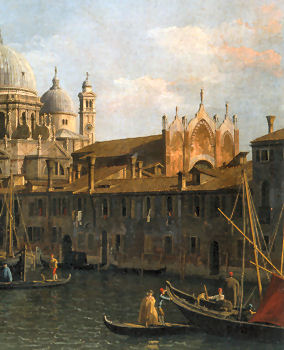 with the Ducal Palace. The entrance to its cloisters, from the Grand
Canal, is somewhat later; a noble square door, with two windows on each
side of it, the grandest examples in Venice of the late window of the
fourth order.
with the Ducal Palace. The entrance to its cloisters, from the Grand
Canal, is somewhat later; a noble square door, with two windows on each
side of it, the grandest examples in Venice of the late window of the
fourth order.
The cloister, to which this door gives entrance, is exactly contemporary
with the finest
work of the Ducal Palace, circa 1350. It is the loveliest cortile I know
in Venice; its capitals consummate in design and execution; and the low
wall on which
they stand showing remnants of sculpture unique, as far as I know, in such
application.
The church in art
The Entrance to the Grand Canal... by Canaletto (see detail
right) shows the church with the façade's original pinnacles.
The Cloister of San Gregorio, Venice by
Margaret Fisher Prout, the daughter of the artist Mark Fisher. An artist
called Myles Birket Foster painted the cloister in the 19th century too,
inhabited by colourful locals, as was his wont.
The church in film
The church and a view of the campo in front of the entrance
(see screen grab
right)
features in
Who saw her
die?
Opening times Closed
Most recently
used by art restorers. But no longer.
August 2021 update A sign on the door in
November 2019 told of plans for San Gregorio to be converted into a museum
of oriental art. Initial work was supposed to have finished in March 2018.
Vaporetto Salute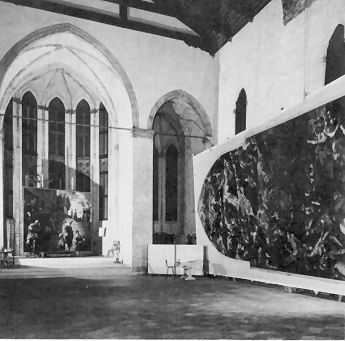
map
Two of the Tintorettos from the Madonna dell'Orto
(The Presentation of the Virgin is in the apse to
the left)
getting
restored in San Gregorio in the late 1960s.
|
|

|
|
San Nicolò dei Mendicoli
12th-16th Centuries
|
|
 History History
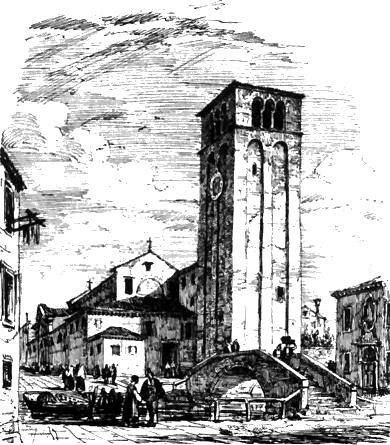
The area around this
church is thought to have been one of the first parts of Venice to be settled,
being so close to the mainland, and tradition says that the first church
here, dedicated to Saint Lawrence, was built in the 7th century by Paduans fleeing the Langobards.
Some books say that this building may have been on the foundations of a
castle. Recent restoration work found the foundations of this earlier
church and discovered that it became
Greek-cross shaped in the 8th century.
Fire in 1106 and 1149 destroyed this original church
and the current church was built. It was
dedicated to Saint Nicholas, Bishop of Myra. The name 'dei Mendicoli' means 'of the
Beggars', reflecting the area's long history as home to Venice's working
classes, traditionally fishermen and their families. But another theory
says that the name derives from Mendigola, the ancient name for the
island on which it was built.
The church was
restored in 1361-4 and remodelled in 1553-80. And in 1750-60 when the new Istrian stone entrance façade was created,
perhaps by the Roman architect Paolo Posi. A priest was imprisoned for not
being able to say where the money for this 18th century rebuilding came
from. It was said that a hoard of Roman gold and silver coins had been
found under the campanile. This story also adding weight to the one
about the church being built on the site of an ancient temple.
There was a total restoration in 1923, when some wall paintings and the
painted ceilings of the aisles and crossing were removed while the nave
ceiling was cleaned. Some where not replaced, and those from the north
and south aisle are said to have been lost.
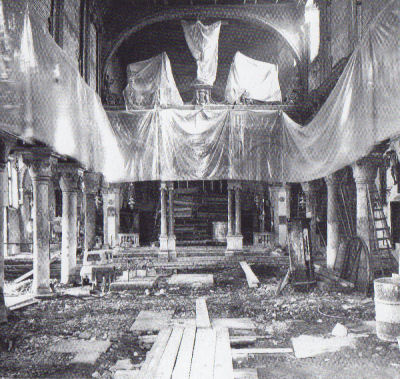
Venice in
Peril carried out major restoration work in the 1970s, after the floods of
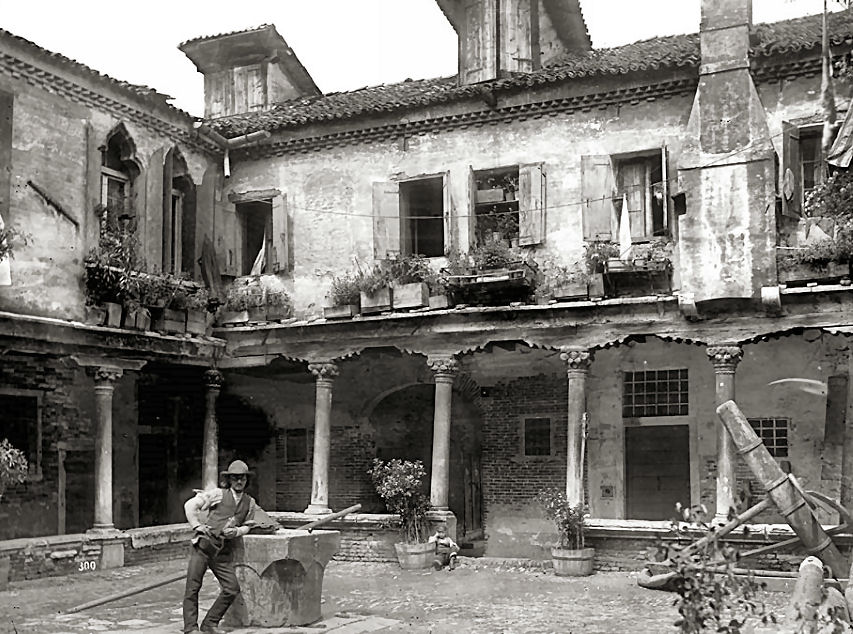
1966 (see black and white
photo below) including
re-roofing, damp-proofing, work on paintings and crucifixes, and the
raising of the floor, which was 30cm below canal level. More careful and
revealing restoration took place in 2003.
The church
The creation of the present, somewhat baroque, Greek-temple-front
side entrance led to restoration work on the old 15th-century porch which was once a common feature but
only this one and those at
San Giacometto
and
Torcello Cathedral remain. It was rebuilt in 1903
using bits of the 12th-century building. Poor and virtuous women were
allowed to shelter and sleep here. The newer entrance has statues of the
Virgin (centre) and Saint Anthony of Padua
and Saint John of Nepomuk (flanking the door).
The interior
A nave with two aisles, the 12th-century basilica
plan features two colonnades of columns with 14th-century capitals
surmounted by rows of statues of the Twelve Apostles dating from the 16th
century. The triple-arched screen between the nave and the sanctuary gives the
impression of aisles on three sides and the three deep chapels in the
right aisle make for a pleasing asymmetrical impression, so it's this
spatial interest that appeals here, and the atmosphere generated by the
darker upper parts.
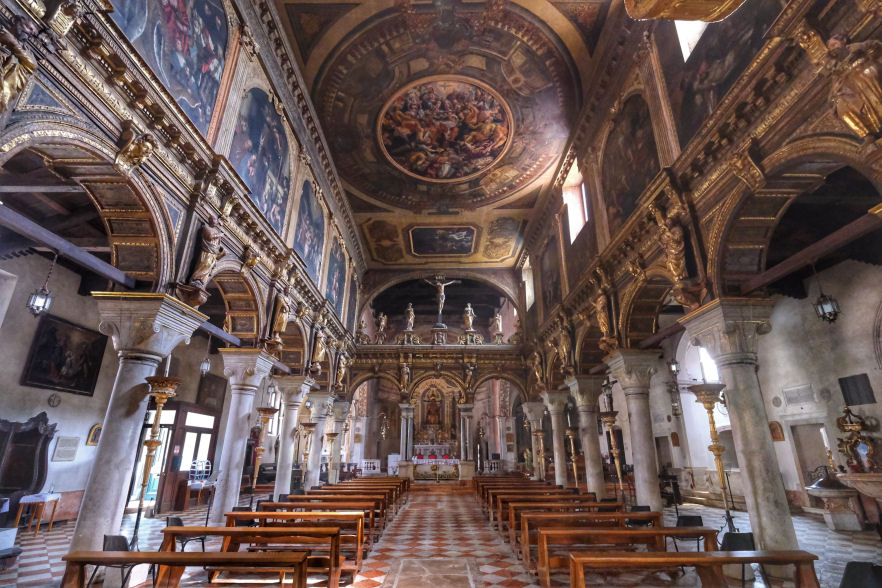
The paintings, mostly late 16th/early 17th century, feature no
big-names - even the Marieschi painting is labelled 'attrib' and there are a
lot of
anonime
works. The nave at clerestory level has ten large scenes from the life of
Christ by Alvise dal Friso, but the Resurrection is by Palma
Giovane. Frescoes over the apse arch of God the Father and The
annunciation are also by Alvise dal Friso. The organ gallery has three
paintings of The Miracles of Saint Marta by Carlotto Caliari, the
son of Veronese.
The ceilings in the nave, crossing and aisles all acquired painted scenes
and decoration during the late-16th-century remodelling. The central
ceiling panel in the nave is The Apotheosis of Saint Nicholas by
Francesco Montemezzano, an associate (possibly pupil) of Veronese.
Either side are two more square scenes from the saint's
life by Leonardo Corona, a Murano-born painter who may have been a late pupil of Titian.
There are varied and attractive paintings on the chapel
ceilings too; and do put a Euro in to illuminate the
place - it cuts down on some of the
shadowy atmosphere but makes it much easier to appreciate the art.
Even more of a mixture of periods and styles than usual, then, but a
pleasing effect nonetheless, and said to be based upon arcane numerical harmonies.
Lost art
Of the 16th-century ceiling paintings, Old and New Testament scenes in the
north aisle, by Leonardo Corona and Andrea Schiavone, were removed in 1923
during
restoration work and are now lost, I have read. The same fate is said to
have befallen the scenes of the Legend of the True Cross and the
Life of the Virgin by Alvise dal Friso. A circular Saint Nicholas
in Glory from the crossing, by Carletto Caliari, Veronese's youngest
son, evidently went into storage.
Campanile
26m (85ft) manual bells
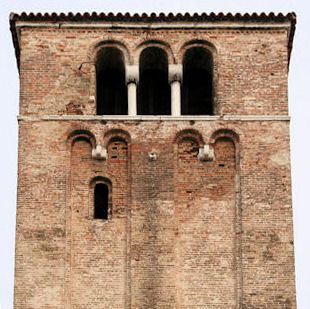
Dates from the 12th-century building. The clock was added in 1764. Damaged by a stray bomb in WWII,
it also benefited from the restoration work by Venice in Peril in the
1970s.
The fresco upstairs
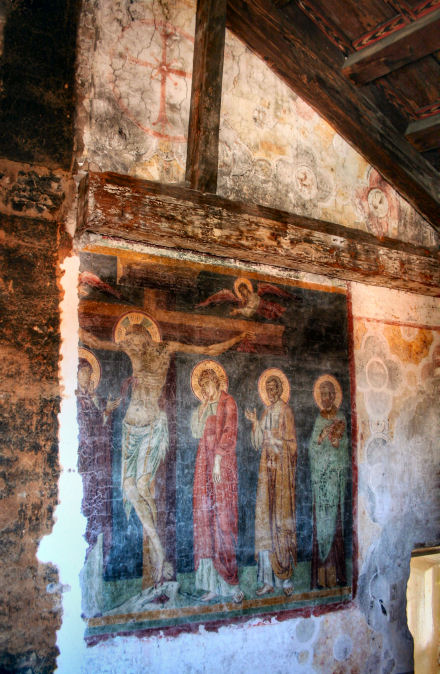
More than half of a
fresco from the 14th century showing the Crucifixion with the
Virgin and Saints
John and two pairs of saints (including Peter and Mark) (photo
right) discovered in the late 1970s in a small space above the apse.
It appears to be the work of two hands, one responsible for the central
figures and angels, the other for the flanking pairs of saints. See my
fresco story
The church in film
This is the main church that Donald Sutherland is restoring in Don’t
Look Now.
Opening times
Mon-Sat 10.00-12.00 & 3.00-5.30
Sunday 9.00-12.00
Vaporetto San Basilio
map
|
|
|
|
|
|