|
|
||
|
|
|
|
|
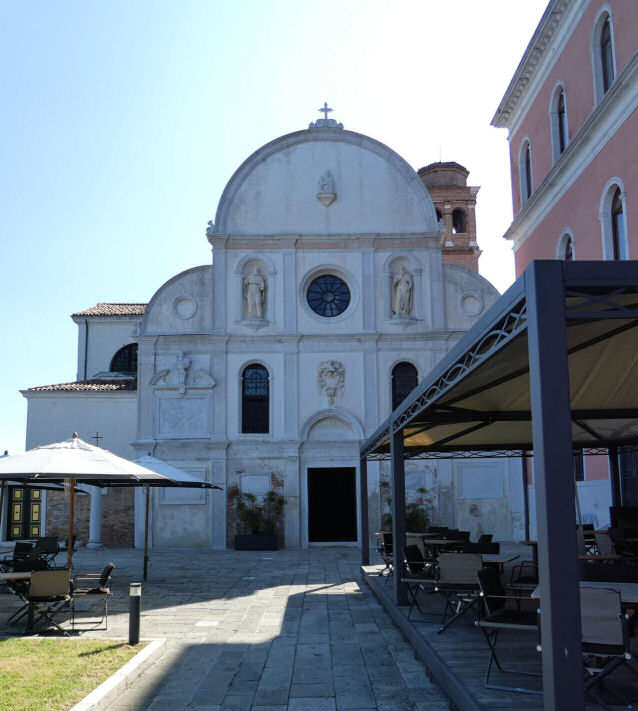
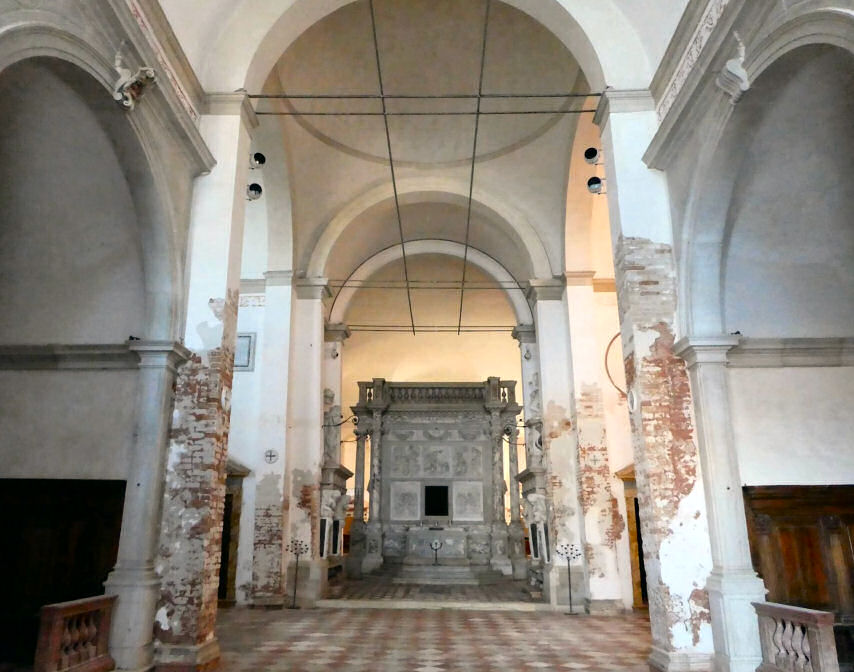
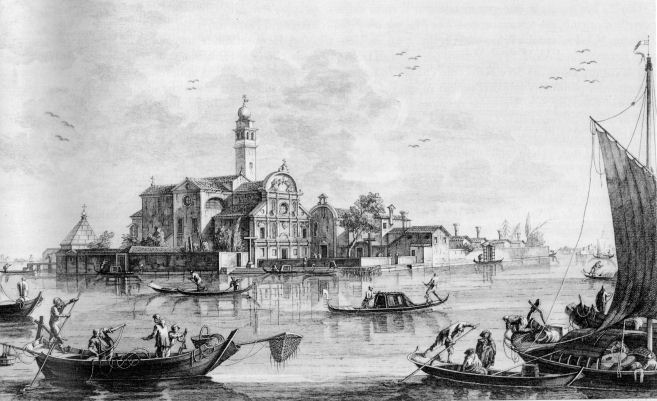
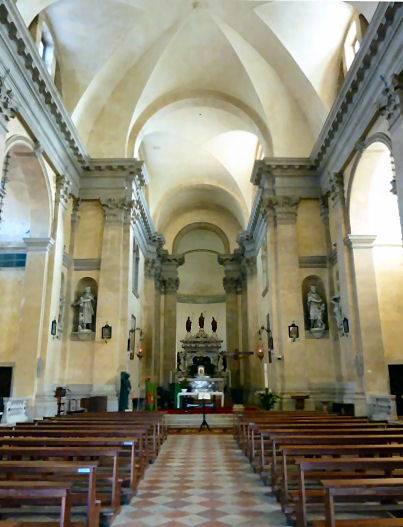
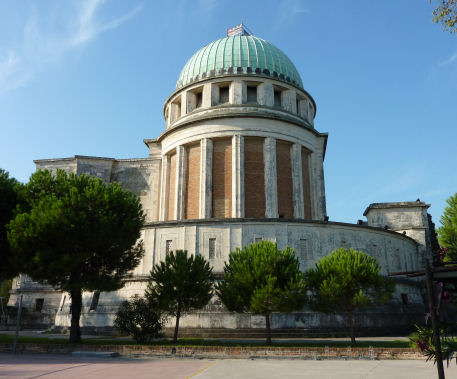
History The original medieval Benedictine church, dedicated to Saint Nicholas of Myra (the inspiration for Santa Claus) was founded in 1044 built between 1053 and 1064 and renovated and enlarged in 1316. The church as you see it today was rebuilt on a different spot, begun by Francesco Contin in 1626 and finished by Matteo Cirtoni in 1629. (The remains of the old church can be found in the adjacent cloisters.) The church houses some 500 bone fragments that are relics of Saint Nicholas - the 4th-century patron saint of sailors and children. Recent anatomical studies and DNA testing have shown that the fragments here and the bones remaining in Bari could come from the same skeleton. The story is that the Venetian Crusader fleet on its way to Joppa (Jaffa) in 1100 stopped off at Bari in search of the bones of St Nicholas, which had been stolen and taken to Bari from Myra. It is said that the Venetians tortured the four Christian keepers of the shrine, but learned nothing. They decided to make do with the bones of Saint Theodore (Venice's patron saint before St Mark) but then a sweet smell began to emanate from behind the altar, leading them to the bones of St Nicholas, which they then took too. It is to this church that the doge came during the Festa della Sensa (or Ascension Day Festival) to celebrate the marriage of Venice and the sea by throwing a gold ring into the lagoon. The ceremony continues to this day, with the Mayor standing in for the Doge. 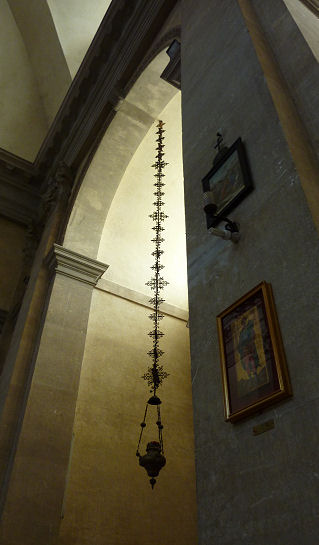 The church The churchThe façade is unfinished. The monument over the main doorway is to Doge Domenico Contarini, who founded the original church in the 11th century, and dates from the 17th century. Interior Inside it looms, with high grubby/sandy walls with mid-grey architectural detailing. Looking down the aisle to where the gap between the walls narrows behind the high altar this detailing looks somewhat too big and out of scale, but elsewhere it's fine. An aisleless nave with three communicating side chapels on each side. There's a baroque high altar of 1630 with a riot of polychrome marble inlay and a sarcophagus on top, where a pediment should be, housing the remains of Saints Nicholas and Theodore. This was the work of Cosimo Fanzago. The wooden choir behind the altar dated 1634 by Giovanni Carlo and Giovanni Cremasco, the latter responsible for the carving of relief panels and other decoration, with panels depicting 27 Episodes from the Life of St Nicholas. Art highlights All from the 17th and 18th centuries. No big names but a nice and warm fresco on the inner façade of Venice Paying Homage to Saint Nicholas by Girolamo Pellegrini. Another highlight is an attractive Ascension by Pietro Muttoni, known as Pietro della Vecchia. The monastery Founded and renovated at the same time as the church, with a cloister added in the 16th century. Suppressed in 1770. Occupied in 1938 by the Friars Minor of San Antonio. It stood in for a Brazilian monastery in the James Bond film Moonraker, which was filmed mostly in Venice. Now a study and research centre. 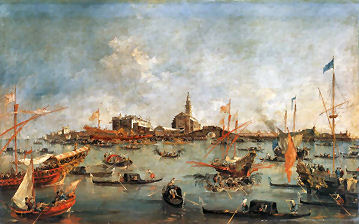 Campanile Baroque, dating from the rebuilding of 1626-1629. The church in art The Doge in the Bucentaur at San Nicolo di Lido on Ascension Day by Guardi (see right) is in the Louvre. Opening times Unpredictable map |
|
|
|
||
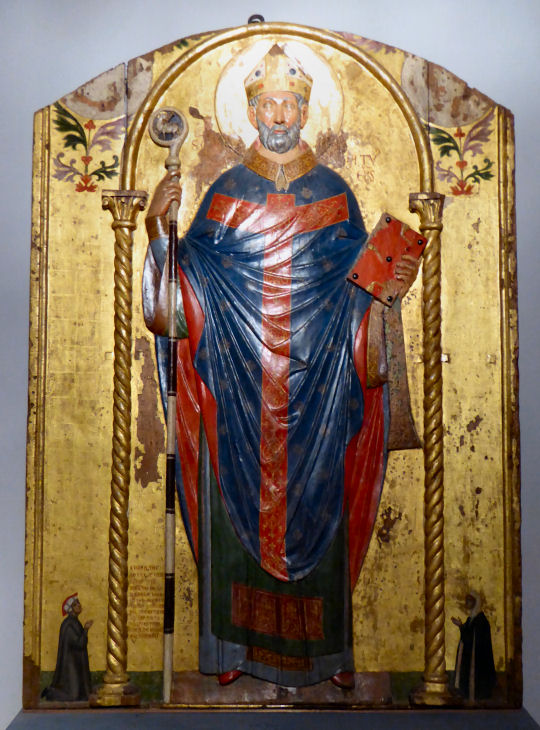
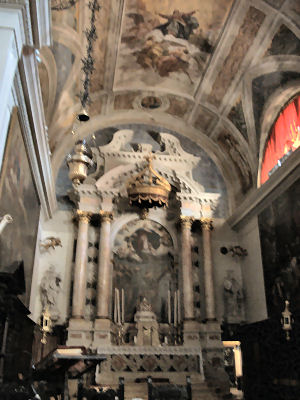 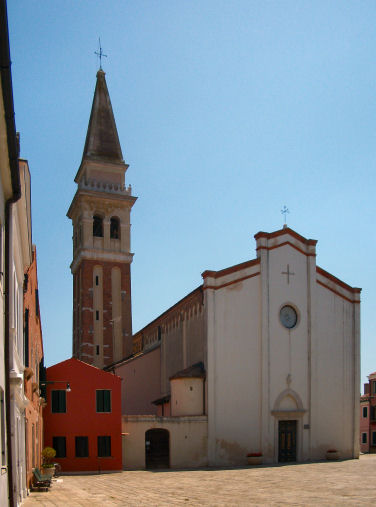 History Founded in the 15th century and rebuilt in 1557. The interior is a single nave with a vaulted roof and contains 17th and 18th century works by Girolamo Forabosco, Lama and Pittoni. Kept in the sacristy is a carved wooden altarpiece from the early 15th century, called 'il Palliotto' ,by Paolo delle Masegne, showing the blessing Christ, Mary's Ascension, and 12 saints (see photo below). 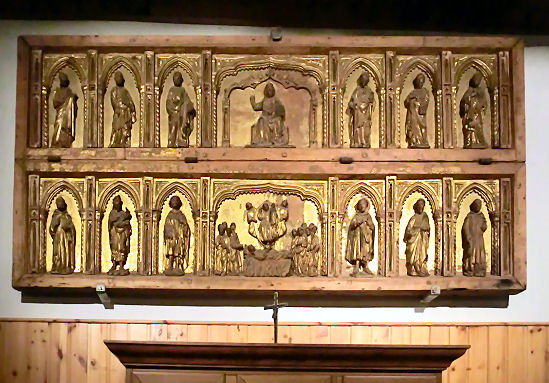 Opening times
Normally Opening times
Normallymap All three Photos by Brigitte Eckert. |
||
|
Santa Maria Elisabetta |
||
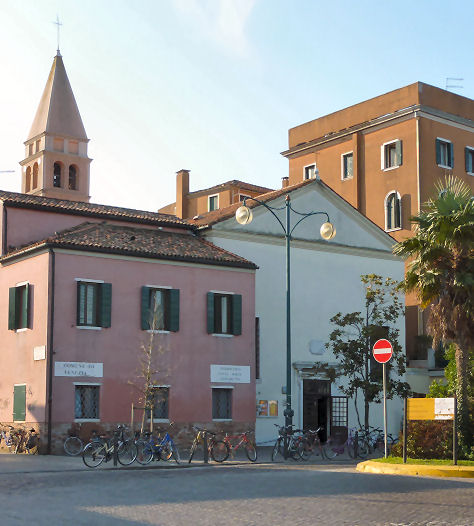 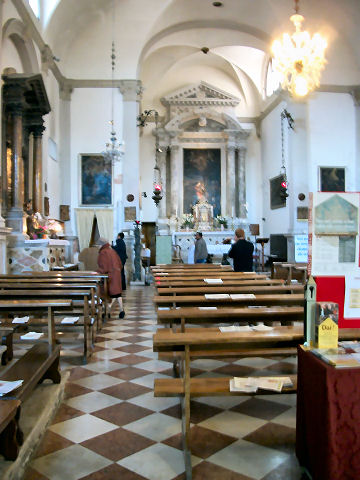 History The Lido's parish church. Built in the mid-16th century as an oratory and enlarged and converted into a church in 1627, with consecration following in 1671. Much restoration around 1970. Interior Small and aisleless with a pair of side altars each side and a high altar in a shallow vaulted apse. The high altarpiece depicts The Visitation. One of the side altars on the left has an altarpiece 'attributed to a student of Salviati' depicting Saints Apollonia, Catherine of Alexandria, and Lucy, with Saint Oswald in Glory. The label in the church also narrows its date down to the last half of the 16th century, or the first half of the 17th. The other altar on the left side has a 16th-century Venetian/Cretan icon of the Virgin and Child and a small 15th century sculpture of The Pieta. On the right-hand altars there's a Virgin in Glory with Saint Nicholas between Saints Gerardo Sagrado and Benedict by Gerolamo Pilotti from 1609 and an early-17th-century Baptism of Christ. Campanile Late 19th century. Opening times Services only map Photo right by Brigitte Eckert. |
||
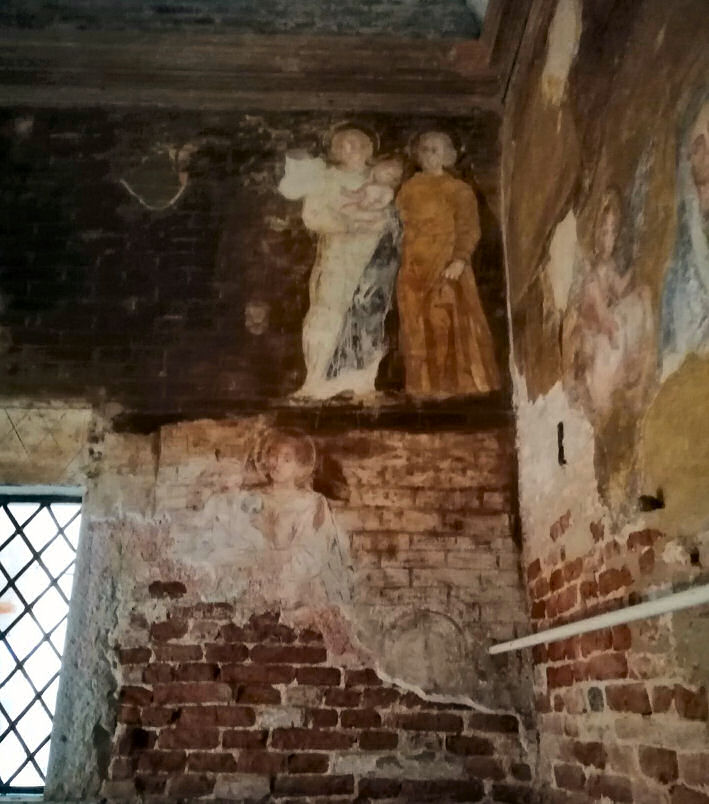
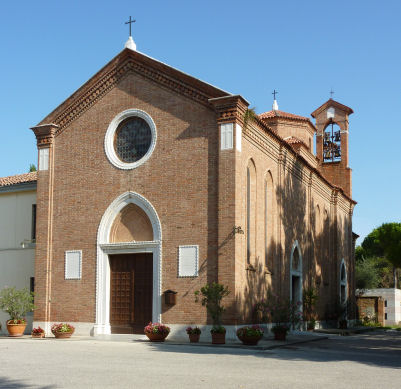 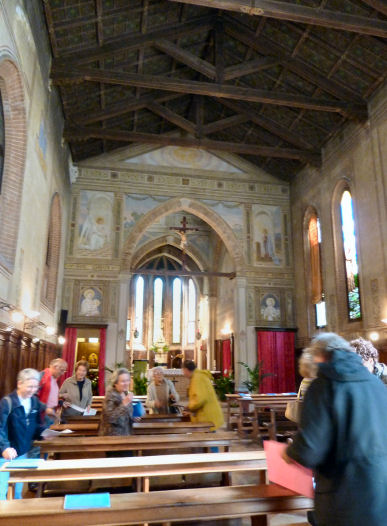 History A small church in the grounds of the Ospedale al Mare, the Lido's large and dilapidated hospital complex, which has been all fenced off for years now, awaiting redevelopment. Built in 1932 to a neo-gothic design by engineer Antonio Spandri. Panel paintings and frescoes by Giuseppe Cherubini, who also painted the ceiling mural in the ospedale's Marinoni Theatre. 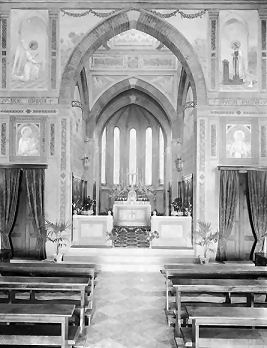 Interior A sweet little space, with a timber roof, pale painted walls and nice olde gothick detailing and frescos belying its lack of actual age (see left). Opening times The church is within the ruined hospital complex which has been all fenced off for years now, awaiting redevelopment. map A photo taken in 1932 |
||
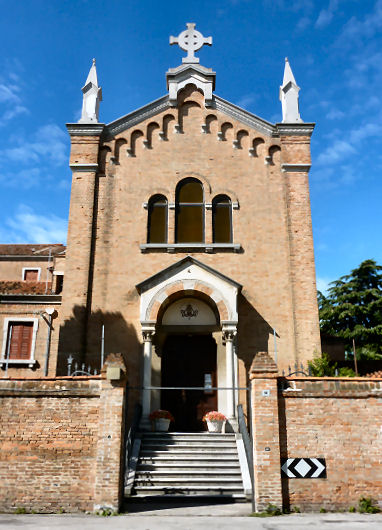 Suore Bianche (Suore del Sacro Cuore?)
Opening times |
|
|
|
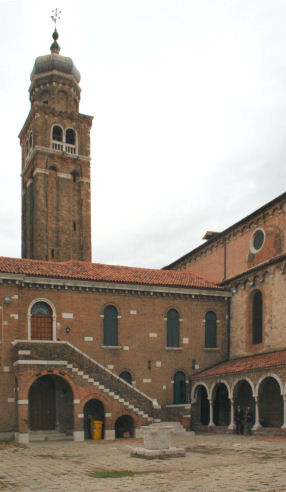
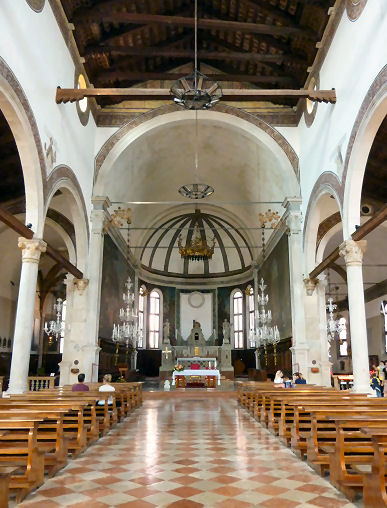
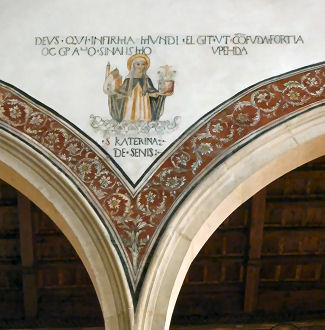
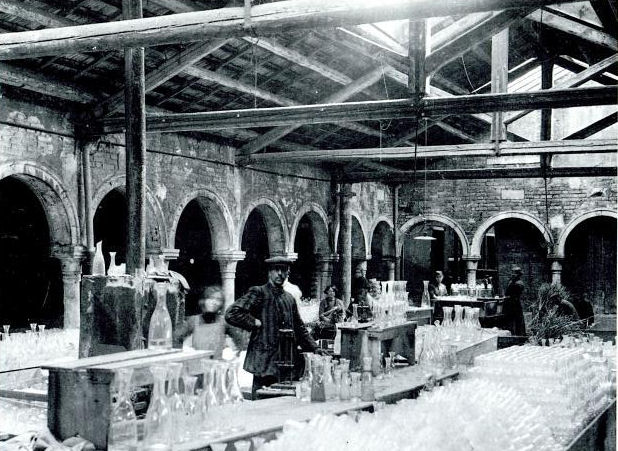
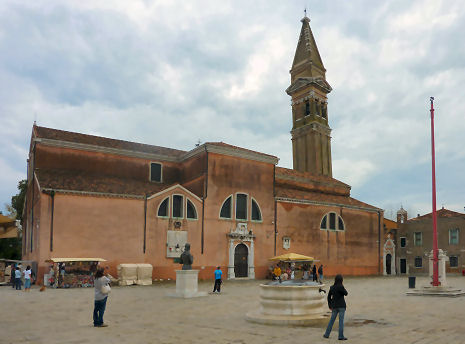
History The original church and Dominican monastery, dedicated to St John the Baptist, was built from 1363, being consecrated in 1417, thanks to a bequest of 1438 by Marco Michiel. A tablet on the far right of the façade commemorates this. This church burned down in 1474 and was rebuilt and enlarged, reopening in 1511 and dedicated to St Peter Martyr. The church was closed in 1806, the monastery taken over by the military, and its art moved to the Accademia Gallery. (Following partial demolition the monastery buildings latter became a primary school, then were used for glass art classes, and later was used by the postal service.) It reopened in 1813 as a parish church due to an initiative by Father Stefano Tosi, with art from other suppressed churches and monasteries on Murano and other islands. At its reopening the church was renamed S. Pietro e Paolo, but reverted to its present name in 1840. The colonnade attached to the west flank of the church (see photo below left) came from the demolished convent of Santa Chiara, being reassembled here in 1924, during the restoration of 1922-28. This period of restoration also saw the the revelation of the original ceiling and the frescos of the saints above the pillars. Interior Impressively spacious and tall - a nave and two aisles, which are divided from each other by rows of four arches. The spandrels between the arches are nicely decorated with saints and some attractive lettering (see right), tie beams across the arches and the nave, with a trussed roof. There's a wide and deep half-domed chancel and a pair of 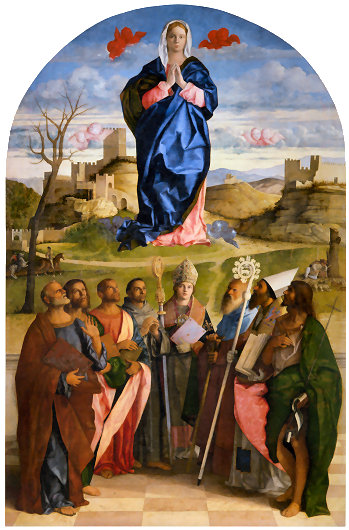 apsidal chapels, also wide and deep.
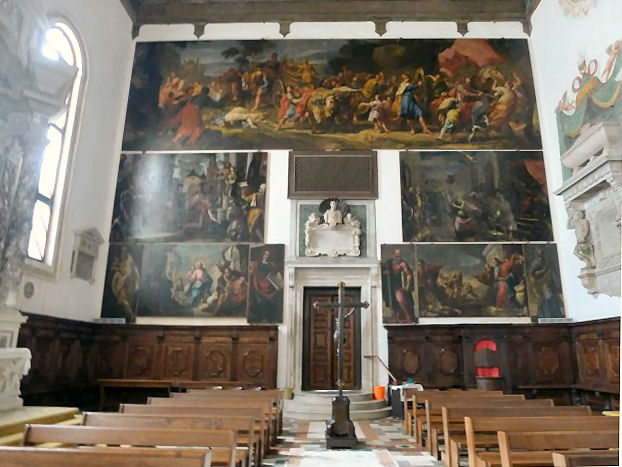
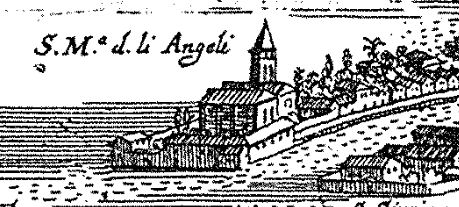
 Art highlights You might read that Giovanni Bellini's late Assumption of the Virgin in Glory with Saints Peter, John the Evangelist, Mark, Francis, Louis of Toulouse, Anthony Abbot, Augustine and John the Baptist. (1510-15) (see right) is in the sacristy here but since the 1990s it's been away being restored. Update It went on display at the Venice Diocesan Museum in October 2016, to celebrate the 500th anniversary of Bellini's death, with the expectation that it would be returned here if the restoration had 'taken'. In January 2017 it was still in the Diocesan Museum, and sadly suffering visibly from its damp and unsuitable surroundings - the angry attendant let me step over the velvet rope to examine the damage. Later in 2017 more restoration work was announced. It was originally on the high altar in the nearby church of Santa Maria degli Angeli, and had previously been thought to be the work of Marco Basaiti. It is now thought to be largely or wholly a studio work, with recent scholarship giving it mostly to Bellini's close friend and collaborator Vittore Belliniano. A Bellini which is here is The Virgin with Doge Agostino Barbarigo. This was originally in the Doge's Palace, for which such images were traditionally commissioned by doges, and hence its non-altarpiece-like horizontal format. It was reframed and moved to the high altar of the church of Santa Maria degli Angeli in 1501, as Barbarigo had requested in his will, two of his daughters having been nuns there. It came here in 1815 and was just recently returned to this church after years spent in restoration. Saints Nicholas, Charles Borromeo and Lucy by Palma Giovane, which came from the demolished church of Santi Biagio e Cataldo on Giudecca. A recognisable (early?) Tintoretto of The Baptism Of Jesus, which came from above the high altar of the demolished San Giovanni dei Battuti on Murano. Two by Paolo Veronese: Saint Agatha Visited in Prison by Saint Peter and an Angel and a better Saint Jerome in the Desert, originally from the nearby church of Santa Maria degli Angeli. (These last two have recently undergone much-needed restoration work and where exhibited at the Accademia in 2017 and in an exhibition at the Frick in New York in earl 2018.) A Virgin and Child with Saints by Giovanni Agostino da Lodi (previously thought to be by Basaiti) came from the demolished church of San Cristoforo delle Pace. In the left-hand apsidal chapel there's a hard-to-see painting by Domenico (a.k.a. son of) Tintoretto. Covering both side walls of the deep chancel are a pair of huge paintings by Bartolomeo Latteri, including an impressively architectural Nozze di Cana.
The sacristy |
|
|
|
|
||
|
|
|
|
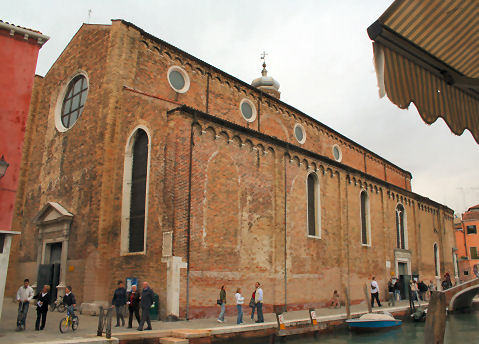
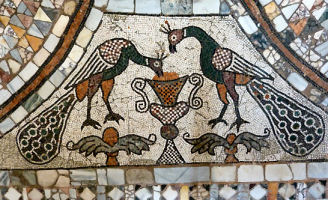
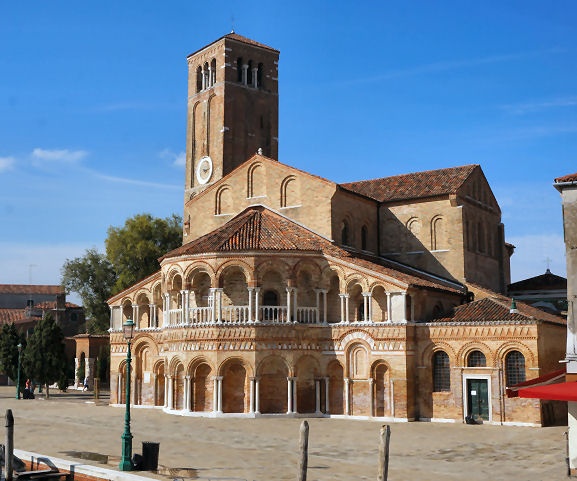
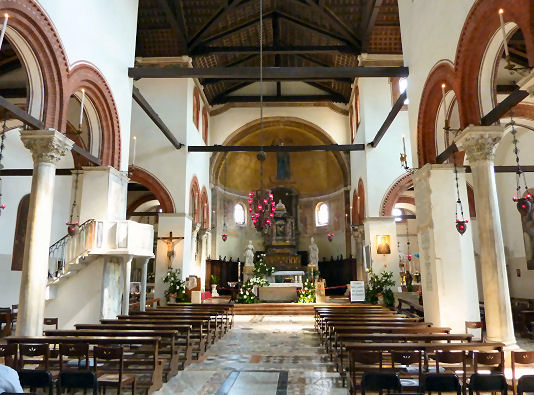
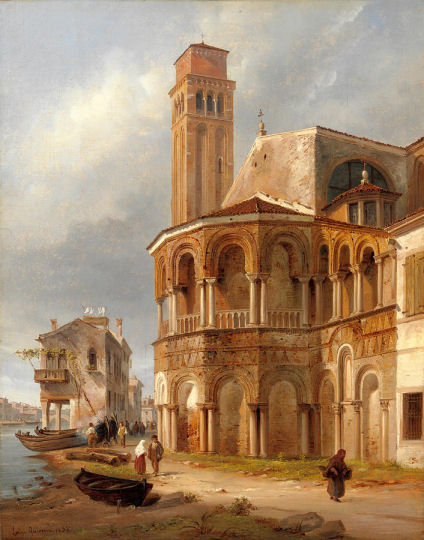
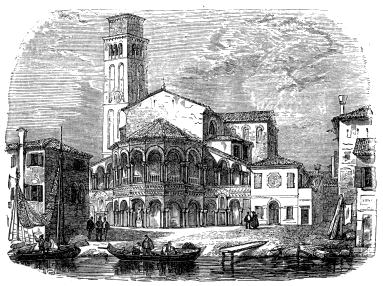
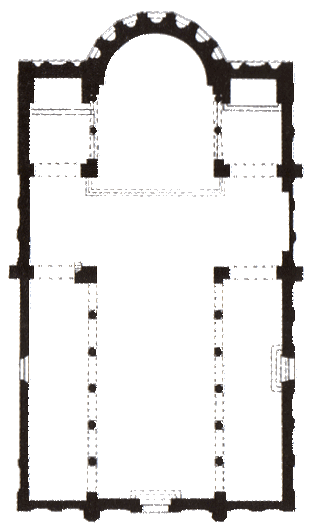 History Legend has it that this church was built by Otho the Great, to whom the Virgin appeared and told him to build her a church in what was then a three-cornered meadow scattered with scarlet lilies. A document of 999 says that refugees from the mainland founded this church in the 7th century and dedicated it to the Virgin. The church was rededicated when the body of Saint Donatus, the patron saint of Murano, was brought here from Cephalonia in 1125 by Doge Domenico Michiel, along with the bones of a dragon the saint had slain. This date also seems to be when the church was built in its current form, with the work completed in 1141, a date which is recorded on the mosaic floor. Some of the remains of San Gerardo Sagredo were translated here in 1333 and the urn is taken to San Giorgio Maggiore every hundredth anniversary of his departure to spend a night there. Baroque redecoration followed in the 18th century and then a restoration in 1858-73 returned the church to its previous appearance, with major rebuilding of the apse. It was this restoration that Hugh Honour condemned for 'bastardising' the church so that it was neither 12th or 18th century in appearance but a bad mixture of the two. A lot of this work was reversed during later restoration, especially in the 1970s, leaving the church very much as it would've appeared in the 12th century. The church Brick and terracotta. The lovely two-tiered blind arcaded apse seen across the campo and the canal is usually one's first, jaw-dropping, view of this church. The plain façade cannot compete.
|
|
|
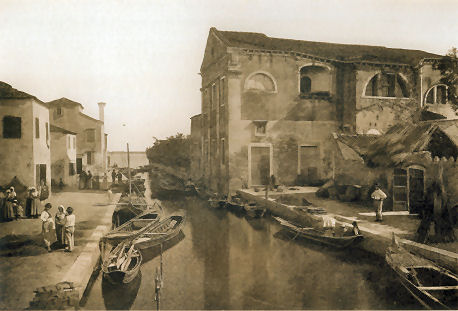 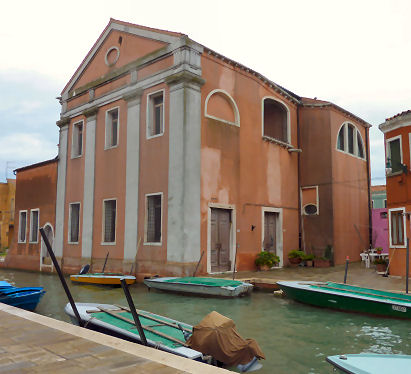 History Built in the 18th century(?) the church of Santa Maria delle Grazie (also known as 'Le Cappuccine') is all that's left of a convent complex which was suppressed in 1806. Vaporetto Burano map 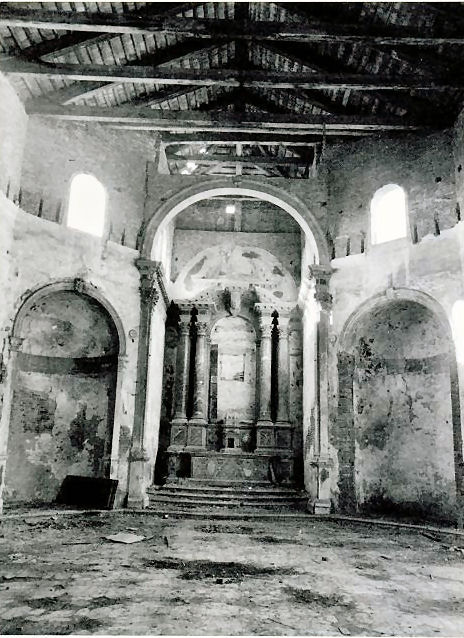
The interior in 1963. |
||
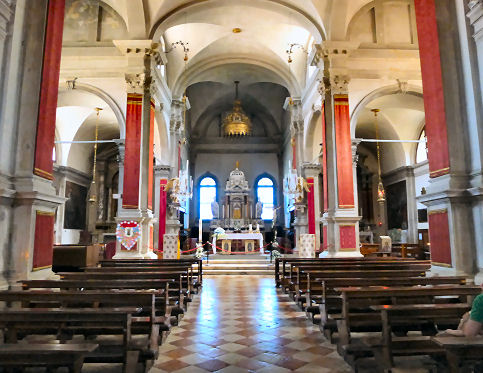
Art
highlights Interior photo by David Orme
Vaporetto Burano |
||
|
|
||
|
|
||
|
|
|
|
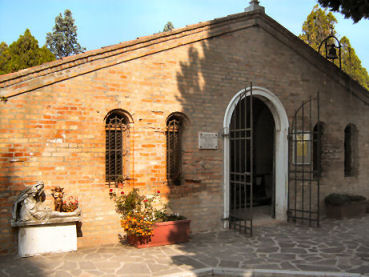 Photo by Brigitte Eckert |
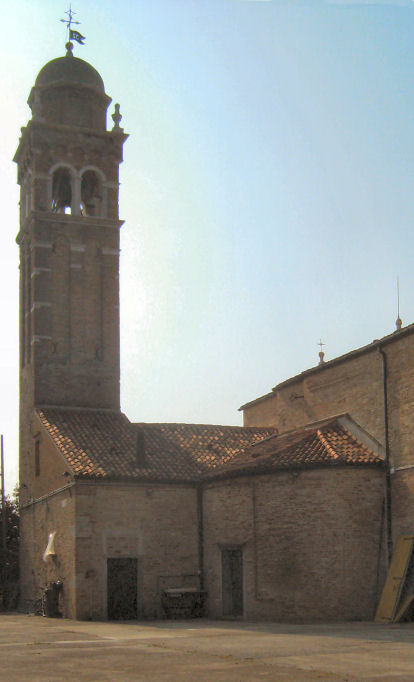
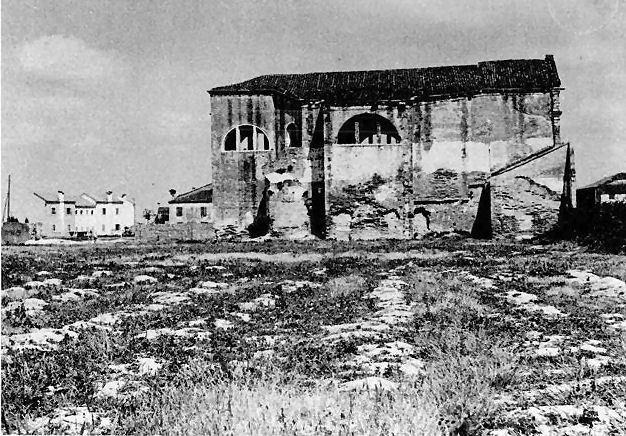
History There was an old church of this name hereabouts, of uncertain date, but it was documented as here by the 12th century. Documents dating to 1699 mention a Romanesque structure with a nave and two aisles. The church was left to crumble from c.1600 until 1747 , when it underwent restoration. In 1807 during the Napoleonic suppressions the church was deconsecrated and passed into private ownership in 1819. The main chapel collapsed in 1825 and the church was demolished in 1828. The area was then used as a cemetery and the current brick chapel built, dedicated to Santa Maria Assunta. Campanile All that remains of the original church, in a Romanesque/Renaissance style, it is in a ruinous state and currently fenced off. It had four bells. The two largest and oldest went to Santa Caterina (see below), one disappeared and the fourth is assumed to be the one that remains. Vaporetto Mazzorbo map |
|
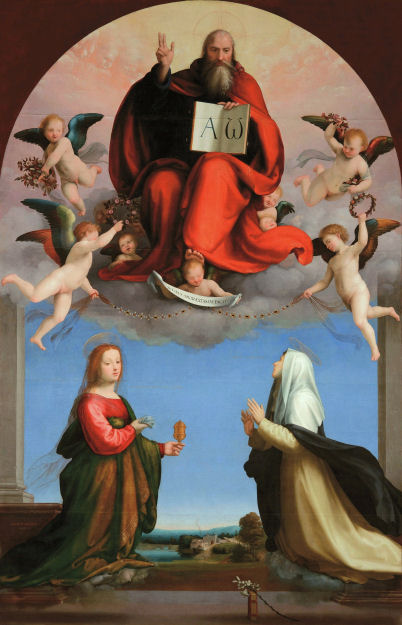
 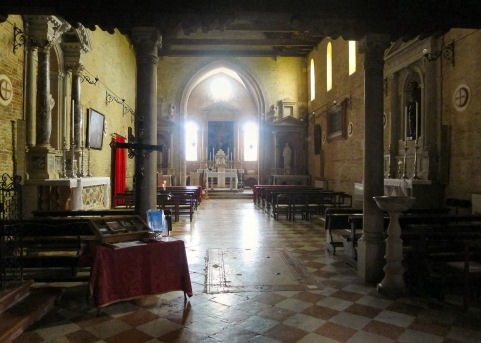 History Between the 7th and 17th centuries four monasteries and five churches were built on the island of Mazzorbo, of which only this one church remains. The original church dates back to 783 and the founding of a Benedictine nunnery. The current building is 14th century Romanesque-Gothic, restored in the 16th century. The convent was suppressed and demolished in 1806 and the church passed to parish use. Further restoration took place in 1922-25. 'Heavy-handed' is the phrase used by my guide book to describe this latter work. The church There's a marble relief of 1368 of The Marriage of St Catherine over the door and a painting of The Baptism of St Catherine and St Mary Magdalene by Giuseppe Salviati over the high altar. There is a barco (nun's gallery) and a ship's-keel roof. Lost art Veronese's Santa Caterina di Mazzorbo altarpiece (see below) is now in the Pitti Palace in Florence. 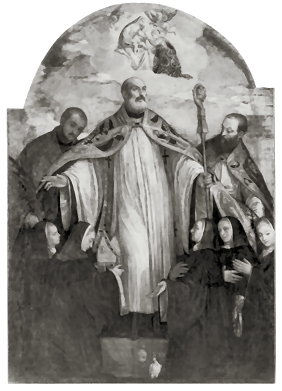 It shows Saint Benedict, his pupils Maurus and Placidus, and his sister
Scholastica with more nuns, and the Mystic Marriage of Saint Catherine
happening in the sky.
It shows Saint Benedict, his pupils Maurus and Placidus, and his sister
Scholastica with more nuns, and the Mystic Marriage of Saint Catherine
happening in the sky.Campanile Of uncertain date, although part of the convent building, and restored in 1762. Has a small dome and a very old bell, dated 1318, originally from San Michele Arcangelo (see above). Bibliography There's a book about the church by Marco Molin (Edition Quaderni Torcellani) published in 2010 and for sale for €10 in the church and at bookshops in Venice.
Opening times April-September Friday-Sunday 11.00-1.00, 2.00-5.00
Campanile photo by Brigitte Eckert.
Interior photo by David Orme. |
||
|
|
||
|
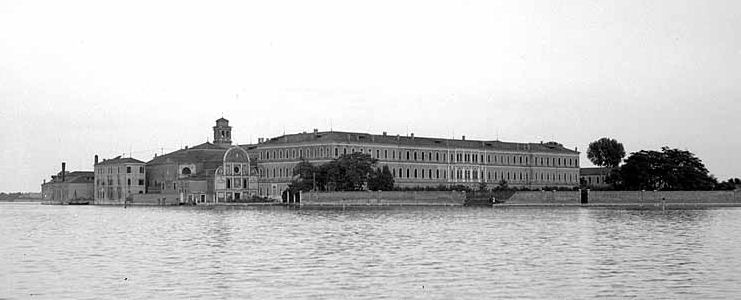
History The Island had long been used to house pilgrims when in 1432 it was given to the canons of the Santa Maria della Carità monastery in Venice. The church, which had been built in the Romanesque style in 1131-60 was enlarged in the late 15th century. In 1630 the island had temporarily been a hospital for plague victims. In 1642 it was bought by the Camaldolite congregation of Monte Rua, who rebuilt the church from 1653-1750. This work has been attributed to Andrea Cominelli in the pay of Bernardo Morosini. The façade of 1488 was restored at this time but kept its Codussi-influenced appearance. Bust of Francesco and Tommaso Morosini, who funded the rebuilding, are to be found on the façade and inside. The monastery was closed by Napoleon and initially put to military use, before most of the monastery complex was demolished. Since then the island has housed a lunatic asylum (from 1844 until 1992, and initially for women only) and a cat sanctuary. A larger complex was built 1858-73, most of which remains. It's now a luxury hotel, looking like a big pink hospital, and recent photos show the sacristy and cloisters being used as a restaurant.
Art highlights
|
|
|
|
|
||
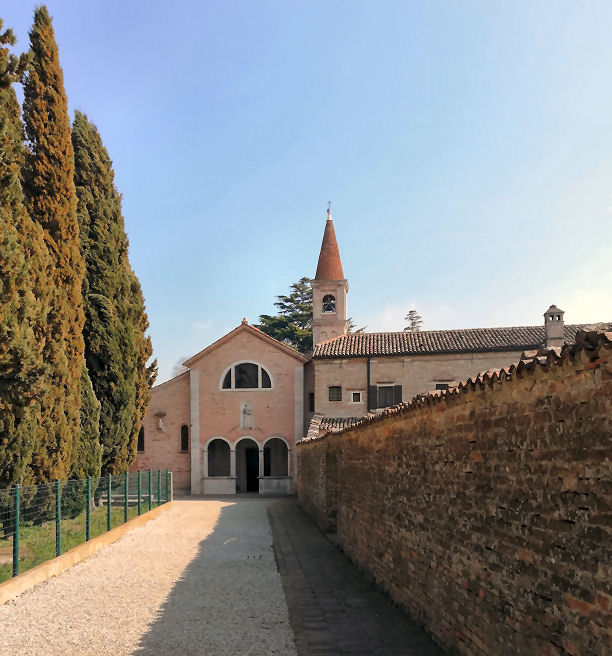 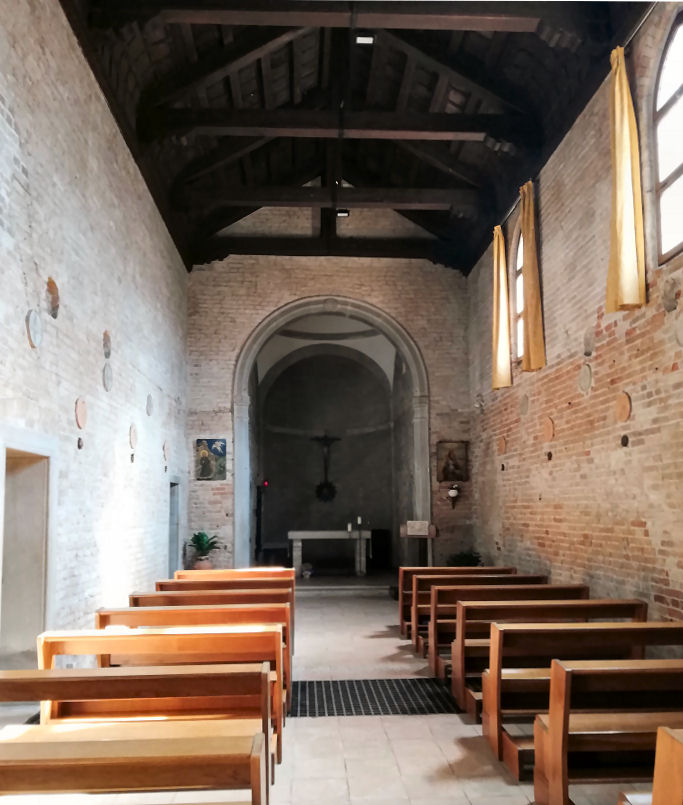 History Tradition says that Saint Francis himself stopped here in 1220 on his return from Egypt and preached to the birds. An old pine tree was said to have sprouted from his walking stick planted in the ground here. (The tree is said to have died naturally in 1701, with bits of it preserved in this church until at least 1970.) The monastery was founded here in 1233, the island having been given to the Franciscans by patrician Jacopo Michiel. It was the the first monastery established after Francis's original one at Assisi. The complex was expanded at the end of the 13th century and restored (with a cloister added) in 1453. The monks deserted the island because of a malaria outbreak in the 15th century (hence the del Deserto in the name) and later were forced off the island by Napoleonic army in the early 19th century, but they returned both times and remain to this day. Major unsympathetic restoration 1921-23, with some reportedly better work in 1962. Not sure when the window removal evident in the comparison of the old and new photos took place - the old photo dates from the 1930s, I think, so presumably the removal happened during the later restoration. The convent in fiction In Pandora's Galley by Macdonald Harris the central character takes refuge here and spends time conversing with Fra Mauro, the renowned mathematician and cartographer monk, who actually lived in the monastery of San Michele. Opening times Tuesday-Saturday 9.00-11.00, 3.00-5.00 Sunday 3.00-5.00 The island is accessible only by private boat. Admission by voluntary donation. 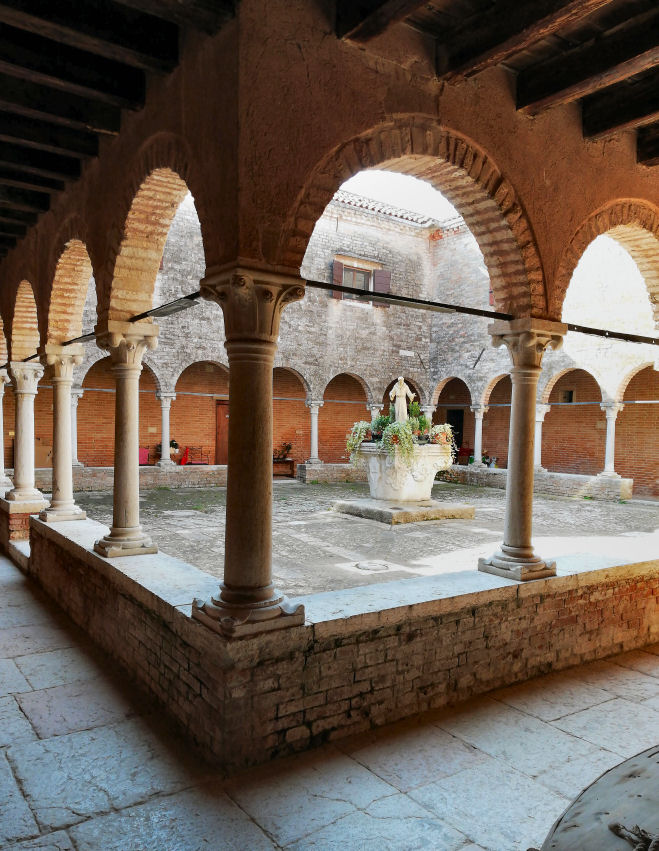 Update
April 2022 It is now possible to book a Update
April 2022 It is now possible to book a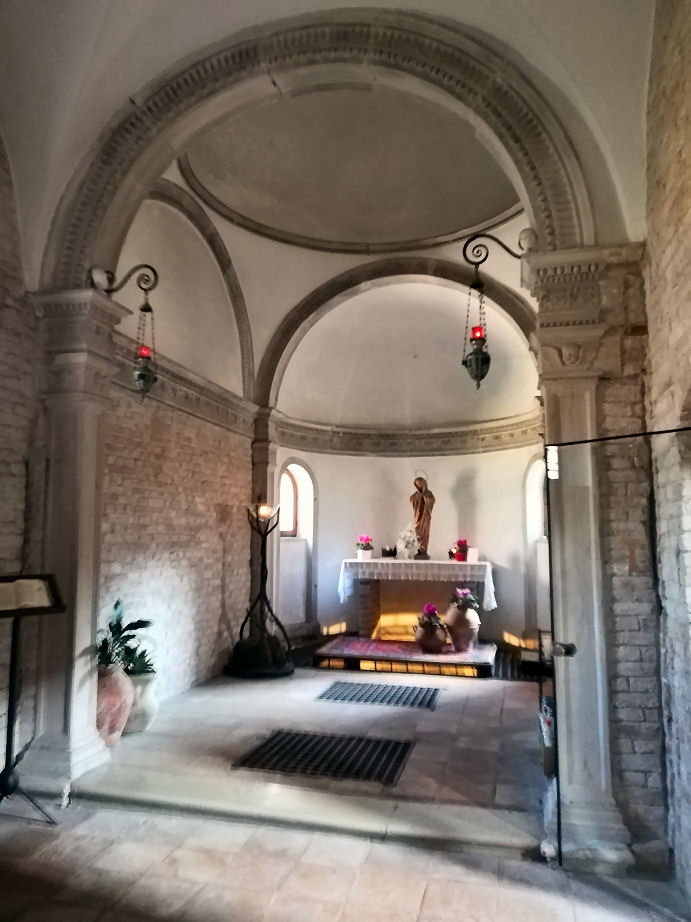 return boat trip online to the island, leaving at 2.30 from Burano. Click
here or here for details.
return boat trip online to the island, leaving at 2.30 from Burano. Click
here or here for details.Update December 2019 For the four recent photos thanks to Alexander Turchik |
||
|
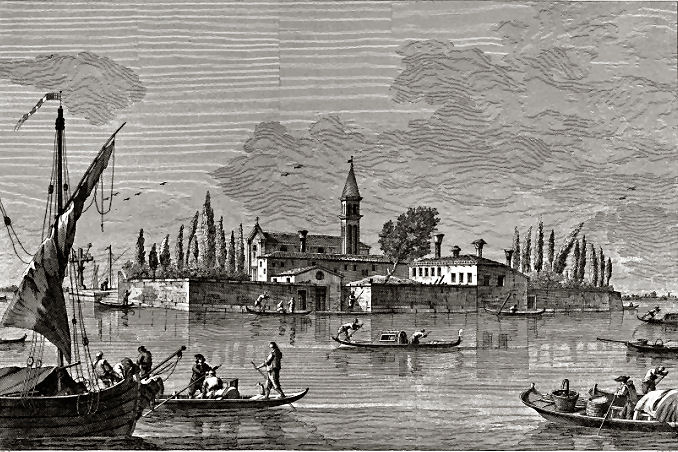
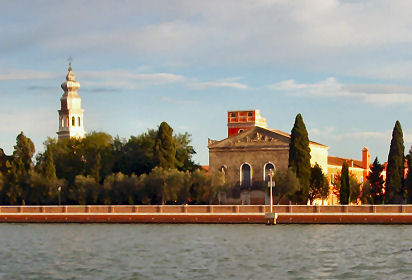
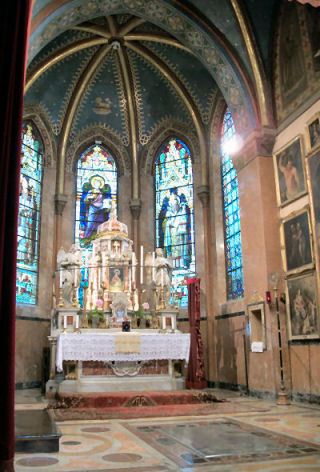
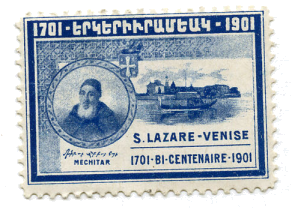
History This island had provided shelter for pilgrims since the 12th century and since many of them had leprosy it was decided to build a hospital here. In Venetian dialect leprosy is 'mal di San Lazzarro' after Lazarus, the beggar who was also a leper. After the lepers were moved out, around 1500, to the new Ospedale di San Lazzaro dei Mendicanti at San Zanipolo, the island was uninhabited for several centuries. In 1717 the island was given to an Armenian monk called Manouk Bedrosian, also known as Padre Mekhitar. He and his 17 monks (known as the Mekhitarist Fathers) restored the existing church and built the monastic complex we see today, which was completed around 1750. There is a library here, a printing press, an archaeological museum and an art gallery - all devoted to Armenian culture and art. The monastery was the only one in Venice to escape closure by Napoleon - he favoured the Armenians and claimed that this was an educational, not religious, institution. 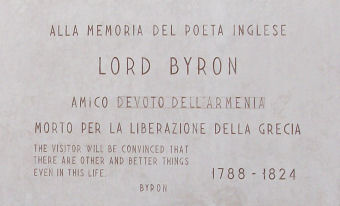 The library (see below) was much visited by Byron - he rowed out three times a week during his visit of 1816/17 - to study Armenian and help with an English-Armenian grammar. A small room off the library contains memorabilia of his visits. 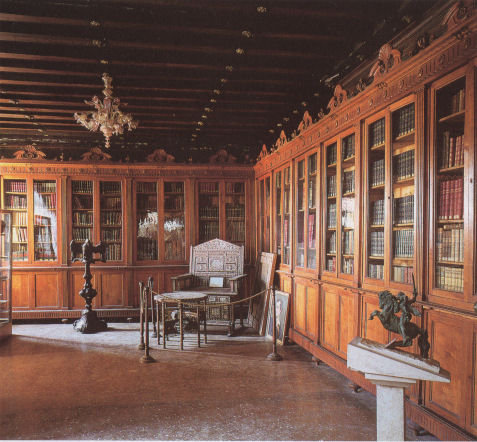 The church An 18th century cloister provides access to the church. There are paintings by Francesco Maggiotto, Francesco Zugno, and Pietro Novelli. More art in the monastic buildings, including works by Giovanni Battista Tiepolo, Sebastiano Ricci, Canaletto and Jacopo Bassano. The church was rebuilt after a fire in 1883. The monastery in literature The premise of A Mapmaker's Dream: The meditations of Fra Mauro, cartographer to the court of Venice by James Cowan is that the story told in the novel is a true one, with the manuscript having been found by a scholar researching the life of Byron in the library of San Lazzaro. Opening times Guided tours 3.20-5.00 daily. Take the 3.10pm vaporetto (line no. 20) from San Zaccaria which is met by the priest who conducts the 75 minute tours of the complex. The admission fee is €6. Vaporetto San Lazzaro Armeni map |
|
|
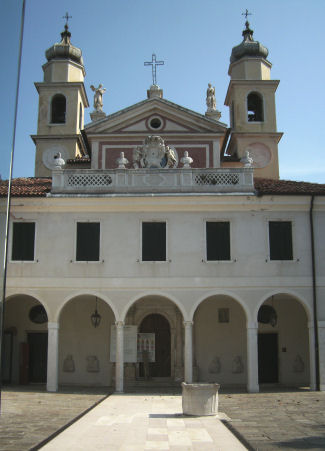 History The island was inhabited from 810 by Benedictine monks, then Benedictine nuns until 1616, when some nuns who'd been chased from Crete by the Turks took possession. Then in 1725 it was converted into a hospital for soldiers by the San Giovanni di Dio Hospitaler Friars. It later became a psychiatric hospital (or an 'asylum for the insane' as an older guidebook puts it) which closed in 1978. There was considerable rebuilding in 1936. The complex currently houses a centre for training in architectural conservation, Venice International University, and since 2006 the Psychiatric Hospital Museum of San Servolo. A church was consecrated in 1470. From 1733-66 the current church and convent buildings were built, to designs by Giovanni Scalfarotto, with the church being the work of his master, Tommaso Temanza. Interior In 1761 Jacopo Marieschi painted the ceiling of the nave with The Glory of San Giovanni di Dio before the Virgin Mary and that of the presbytery with The Three Theological Virtues. In 1810 a Nacchini organ was acquired from the suppressed church of Santa Maria del Pianto. 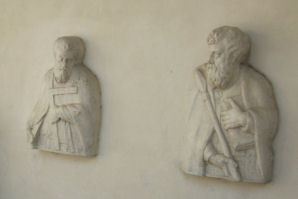 Campanile CampanileCompleted on the 15th of September 1456 according to a plaque. The asylum in poetry and fiction In Shelley's poem Julian and Maddalo he commemorates a visit that he made to San Servolo with Byron to visit a man driven mad by a lover's abandonment. The place is described as a 'windowless, deformed and dreary pile'. San Servolo was also the setting for Jeannette Winterson’s 1987 novel The Passion. Vaporetto San Servolo (line no. 20 from San Zaccaria) Opening times The island has a website as does the Psychiatric Hospital Museum. map Both photos by Brigitte Eckert |
||
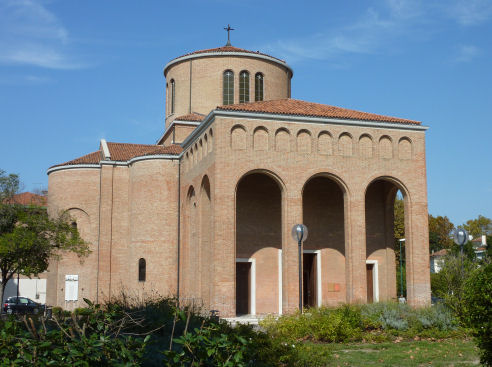
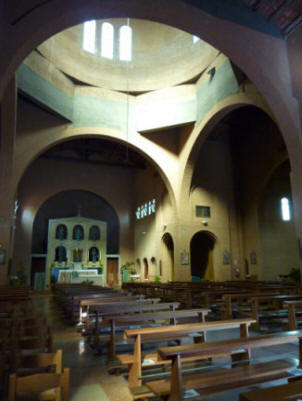
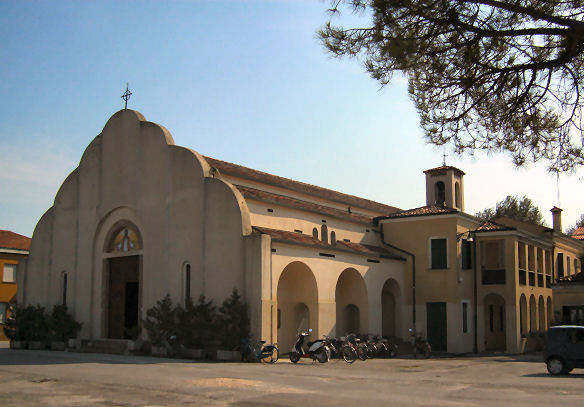 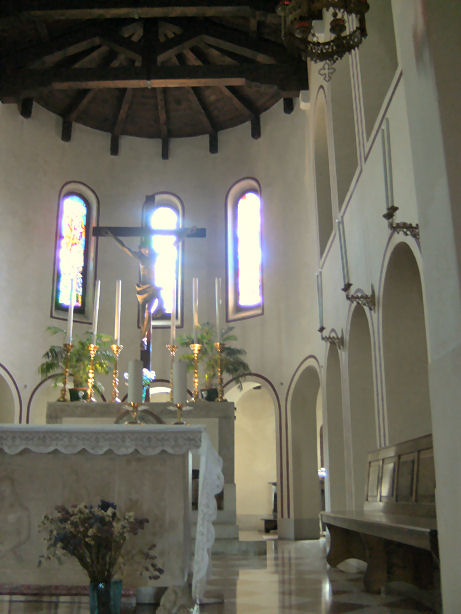 History The original church of Sant'Erasmo, which was built in ? at the southern end of the island of the same name, was altered first in the 16th century and then again in the 18th. A drawing by Giacomo Guardi in the Museo Correr Library shows a church with two rectangular facades and a bell-tower similar to that of Sant'Alvise. That church was demolished by Napoleon. The present Romanesque-revival church, designed by Brenno del Giudice and built in the middle of the island, was consecrated Cristo Re (Christ the King) on the 27th of October 1929. Interior Inside there is a Martyrdom of Sant'Erasmo, by the school of Tintoretto. The Famous Artichoke The island of Sant'Erasmo is now mostly famous for its market gardens, and the Violet Artichoke Festival, at the Massimiliana Tower in the second Sunday of May. Vaporetto Chiesa map Both photos by Brigitte Eckert |
||

Home
Cannaregio ::
Castello :: Dorsoduro ::
Giudecca :: San Marco ::
San Polo :: Santa Croce
:: The Islands :: Demolished

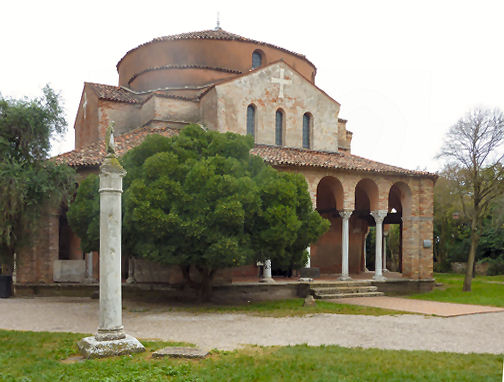
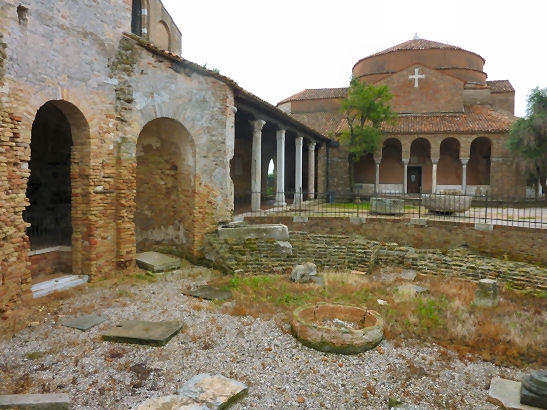
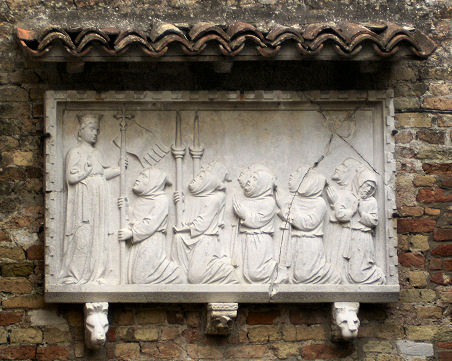 the exterior there is a colonnade around five of the eight sides and an early 15th
century bas-relief St Fosca Being Worshipped by her Confreres (see
right,
photo by Brigitte Eckert).
the exterior there is a colonnade around five of the eight sides and an early 15th
century bas-relief St Fosca Being Worshipped by her Confreres (see
right,
photo by Brigitte Eckert).